I do love the textile designs of Lucienne Day. She and her husband Robin Day were a mid-century design power duo, often referred to as the British Eameses. Her designs were so groundbreaking and enduring that people still refer to them by name.
Désirée Lucienne Day was born in 1917 and died this year aged 93. Inspired by abstract art, she pioneered the use of bright, optimistic, abstract patterns in post-war England, and eventually grew celebrated worldwide.
Born in Coulsdon, Surrey, England, Day was daughter of an English mother and a Belgian father who worked as an insurance broker. She attended convent school in Worthing, and at 17 enrolled in the Croydon School of Art, where she discovered a love of printed textiles. Later she attended the Royal College of Art, where she was a top student.
Through her career, Lucienne Day won many awards, including the International Design Award of the American Institute of Decorators in 1952, and the Gran Premio prize at the Milan Triennale in 1954. In 1962, she was made a Royal Designer for Industry (RDI), an award which honours designers who have achieved "sustained excellence in aesthetic and efficient design for industry." She was the fifth woman to be made an RDI.

Her work combined organic shapes with bright patterns inspired by contemporary abstract painters such as Wassily Kandinsky and Joan Miró. She believed that good design should be affordable, and in 2003 told the Scotsman newspaper that she had been "very interested in modern painting although I didn’t want to be a painter. I put my inspiration from painting into my textiles, partly, because I suppose I was very practical. I still am. I wanted the work I was doing to be seen by people and be used by people. They had been starved of interesting things for their homes in the war years, either textiles or furniture."
Her breakthrough print was “Calyx” (see below), a brightly-coloured textile that she created for the Festival of Britain in 1951. She went on to produce hundreds of colourful abstract prints for industry clients such as Heal's.
In the 1970s, Day stopped designing mass production fabrics, turning instead to creating what she called “mosaics”: large tapestries made of thousands of pieces of Thai and Indian silk. They currently hang in the Victoria and Albert Museum, the Queen Elizabeth II Conference Centre, and the coffee shop of a John Lewis store in Kingston upon Thames.
Through a career spanning more than five decades, she stood out not just because she was a highly successful working woman during a time in which many women didn't work, but also due to her creative partnership with her husband, furniture designer Robin Day. For 50 years they worked, together but independently, in a shared studio, and their house grew to be considered the epitome of 1950s sophistication.
The development of their styles can be traced in Lesley Jackson's book Robin and Lucienne Day: Pioneers in Modern Design, published in 2001. An exhibition of Lucienne Day's textiles and Robin Day's furniture, "Robin and Lucienne Day: Design and the Modern Interior", will be held in Spring 2011 at Pallant House Gallery in Chichester — the city where the Days retired in 2000, in order to be closer to their Sussex cottage, where Lucienne spent much of her time in the garden.
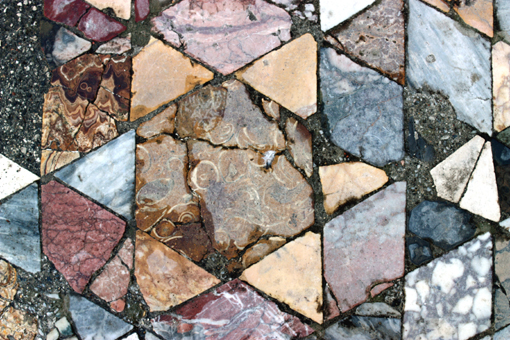
The last of my posts on things seen recently at the excavated sites of two of the Roman towns devasted in 79 A.D. by the sudden eruption of Vesusius. They give a hint of the opulence and stunning colourful decor of the grand villas of the towns.
Visiting just two of the Roman cities devastated by the eruption of Vesuvius in 79 A.D. one realises the scale of the disaster, and how terrible an event it was. Most of the population of Pompeii had left after what they'd always believed was just a mountain overshadowing the city started smoking ominously. Ten percent remained and perished in the poisonous fumes and ash that inundated the city.
In Herculaneaum the city was buried by mud flows, and is better preserved as a result. One is struck by how beautiful and civilized the city and its grand villas must have been - walls and ceilings richly decorated, floors covered in intricate mosaics and colourful marble tiles. These are some of the floors I photographed there.
About a hundred years ago, the first time I went to New York, I was invited along to Push Pin Studios by the English illustrator Barry Zaid who had recently been recruited. I was lucky enough to meet co-founder Seymour Chwaste while I was there but disappointingly, Milton Glaser the other founder, incredibly talented designer, illustrator and typographer - and now very famous for creating the I [heart] NY logo, was away at the time, though I did get to have a drink with him in London in the 70’s when he interviewed my other half, the illustrator Pauline Ellison about a work project.

In 1954 Glaser was a founder, and president, of Push Pin Studios formed with several of his Cooper Union classmates. Glaser's work is characterized by directness, simplicity and originality. He uses any medium or style to solve the problem at hand. His style ranges wildly from primitive to avante garde in his countless book jackets, album covers, advertisements and direct mail pieces and magazine illustrations. He started his own studio, Milton Glaser, Inc, in 1974. This led to his involvement with an increasingly wide diversity of projects, ranging from the design of New York Magazine, of which he was a co-founder, to a 600 foot mural for the Federal Office Building in Indianapolis.

Throughout his career he has had a major impact on contemporary illustration and design. His work has won numerous awards from Art Directors Clubs, the American Institute of Graphic Arts, the Society of Illustrators and the Type Directors Club. In 1979 he was made Honorary Fellow of the Royal Society of Arts and his work is included in the Museum of Modern Art, the Victoria and Albert Museum, the Israel Museum and the Musee de L'affiche in Paris. Glaser has taught at both the School of Visual Arts and at Cooper Union in New York City. He is a member of Alliance Graphique International (AGI).
In 2009, he was awarded the National Medal of Arts by President Barack Obama.