Monday, 14 August 2023

Caravaggio - part 3

Michelangelo Merisi (Michele Angelo Merigi or Amerighi) da Caravaggio, born the son of Fermo Merisi of Caravaggio in Milan, he trained there from 1584 onwards as an apprentice to Simone Peterzano. The date of his arrival in Rome is not documented. In the mid-1590s, he was taken into the household of his patron, Cardinal Francesco Maria del Monte, in the Palazzo Madama. Through Del Monte, he met Vincenzo Giustiniani, another important patron. In 1599, Caravaggio received his first public commission, the painting of the altarpieces of the Contarelli Chapel; this was followed by the side paintings in the Cerasi Chapel. From 1602/03 on, he was commissioned to paint works for the most important Roman families, including the Matteis, the Barberinis and the Borgheses. In May 1606, Caravaggio killed Ranuccio Tomassoni in a dispute, whereupon he fled to Naples. From 1607 on, he stayed in Malta, but was forced to flee from the island the following year due to a conflict and, after a one-year sojourn in Sicily, returned to Naples. On his journey back to Rome, Caravaggio died in Porto Ercole on 18 July 1610.


For more biographical notes see part 1, and for earlier works, see parts 1 & 2 also.

This is part 3 of a 3-part series on the works of Caravaggio:


c1605 Christ on the Mount of Olives
oil on canvas 154 x 222 cm
(Gemäldegalerie, Berlin - destroyed in WWII 1945)

The painting's authenticity has been disputed, but it is well attested in the collection of Marchese Vincenzo Giustiniani and his brother Cardinal Benedetto Giustiniani, its dimensions being virtually identical with those of a Caravaggio of the same subject listed in the Giustiniani inventory. In addition the model for Saint Peter (the reclining figure) appears identical with the two St Jeromes from Caravaggio's Roman period, Saint Jerome in Meditation and Saint Jerome, both around 1605-1606.

The subject is the episode related in the Gospel of Matthew (Matthew 26), when Jesus and his disciples went up to the Mount of Olives outside Jerusalem on the night when Christ was arrested; Jesus goes apart to pray, and returns to find the disciples sleeping. He awakens Peter with the rebuke, "What, would none of you stay awake with me one hour? Stay awake, and pray that you may be spared the test, for the spirit is willing, but the flesh is weak.” Judas then arrives with the Roman soldiers, and Christ's pointing finger seems to indicate their approach. The other two figures are Saint John (centre) and Saint James.


c1605 Saint Jerome in Meditation
oil on canvas 140.5 x 101.5 cm
Museum of Montserrat, Spain

Saint Jerome, hermit, Father of the Church, and responsible for the translation of the Bible into Latin, (the Vulgate Bible) was a popular figure in Caravaggio's time, and the artist painted him at least eight times (only three survive). Whether this was from personal choice or at the request of patrons is unknown, but it gave Caravaggio the opportunity to explore the potential – from an artist's perspective – of aged and wrinkled flesh. Jerome is shown here contemplating one of his symbols, the skull, a reminder of the inevitability of death and the vanity of worldly things.

The painting is probably from the Giustiniani collection (the collection of Caravaggio's patron the banker Vincenzo Giustiniani and his brother the cardinal Benedetto). Benedetto built up a large collection of religious works by the artist, and a St Jerome of the same dimensions as this one is in the Giustiniani inventory of 1638.


1606 Madonna with the Serpent
(aka Madonna and Child with St Anne)
oil on canvas 292 x 211 cm
Galleria Borghese, Rome

The painting was briefly exhibited in the parish church for the Vatican, Sant’Anna dei Palafrenieri, before its removal, presumably due to its unorthodox portrayal of the Virgin. It was subsequently sold to Cardinal Scipione Borghese, and now hangs in his palazzo (Galleria Borghese) where it shares space along with five other paintings by Caravaggio.

While not his most successful arrangement, it is an atypical representation of the Virgin for its time, and must have been shocking to some contemporary viewers. The allegory, at its core, is simple. The Virgin with the aid of her son, whom she holds, tramples on a serpent, the emblem of evil or original sin. Saint Anne, whom the painting is intended to honour, is a wrinkled old grandmother, witnessing the event. Flimsy halos crown the upright; the snake recoils in anti-halos. Both Mary and Jesus are barefoot; Jesus is a fully naked uncircumcised child. All else is mainly shadow, and the figures gain monumentality in the light.


1606-07 The Seven Works of Mercy
oil on canvas 390 x 260 cm
Pio Monte della Misericordia, Naples

The painting was made for, and is still housed in, the church of Pro Monte della Misericordia in Naples. Originally, it was meant to be seven separate panels around the church; however, Caravaggio combined all seven works of mercy in one composition which became the church’s altarpiece. 

American art historian John Spike notes that the angel at the center of Caravaggio's altarpiece transmits the grace that inspires humanity to be merciful.

Spike also notes that the choice of Samson as an emblem of Giving Drink to the Thirsty is so peculiar as to demand some explanation. The fearsome scourge of the Philistines was a deeply flawed man who accomplished his heroic tasks through the grace of God. When Samson was in danger of dying of thirst, God gave him water to drink from the jawbone of an ass. It is difficult to square this miracle with an allegory of the Seven Acts of Mercy since it was not in fact the work of human charity.


1607 Portrait of Fra Antonio Martelli
oil on canvas 118.5 x 95 cm
Pitti Palace, Florence

The portrait depicts one of the grand knights who in 1565; efficaciously defended the island of Malta from a much larger Ottoman Army. Until recently it was thought that this painting represented Alof de Wignacourt, Grand Master of the Order of the Knights of Malta, and that it was a preparatory study for the large and famous Portrait of Alof de Wignacour and his Page, but recent documentary discoveries indicate that it is the portrait of another prominent member of the Order, Antonio Martelli of Florence, Prior of Messina.


1609-10 Salome receives the Head of John the Baptist
oil on canvas 91.5 x 106.7 cm
The National Gallery, London

The story of the death of John the Baptist is related in the Gospel of Mark (6: 16–29). John had criticised King Herod for marrying his brother’s wife, Herodias, and she sought revenge. At Herod’s birthday feast, Herodias’s daughter Salome so delighted the King by her dancing that he promised her anything she wanted. Encouraged by her mother, she asked for the Baptist’s head, and the King had John executed.

This is a late work by Caravaggio, probably painted towards the end of his life. He has reduced the story to its essentials, focusing on the human tragedy and conveying the scene’s emotional power through a restricted range of colour, pronounced chiaroscuro and dramatic gesture. The brutish executioner places John’s head on a salver held by Salome, whose serious expression and sidelong glance are enigmatic. An elderly maidservant clasps her hands in grief, setting the emotional tone. Characteristic of Caravaggio’s mature works, the composition appears simple but actually hides a sophisticated physical and psychological interplay between the main protagonists.


1607 St. Jerome Writing
oil on canvas 117 x 157 cm
Saint John's Co-Cathedral, Valetta, Malta

The coat of arms in the bottom right corner of the painting is that of Ippolito Malaspina, Prior of the Order of the Knights of Saint John (the Knights of Malta) in Naples. Malaspina was a relative by marriage of Caravaggio's patron Ottavio Costa, a friend of his other patrons the Giustiniani brothers, and a cousin of Giovanni Andrea Doria, Prince of Genoa, who two years before had sheltered the artist after an earlier flight from Rome. It's possible that he may have had himself represented as the saint. Saint Jerome was thus a very important painting for the artist.

The subject seems oddly un-martial for a commission by a man whose raison d'etre was to fight the Turks – St Jerome was venerated as the translator of the Bible, which he is seen doing here. But Malaspina was not only a famous warrior, he was also a commissioner for the poor, orphans, and widows, and the painting may have been intended to emphasise both this aspect of his work and also the asceticism of the Order.


1607 The Crucifixion of Saint Andrew
oil on canvas 202.5 x 152.7 cm
The Cleveland Museum of Art, Ohio

The martyrdom of Saint Andrew, was supposed to have taken place in Patras, Greece. The Saint, bound to the cross with ropes, was said to have survived two days, preaching to the crowd and eventually converting them so that they demanded his release. When the Roman Proconsul Aegeas - depicted lower right, ordered him taken down, his men were struck by a miraculous paralysis, in answer to the saint's prayer that he be allowed to undergo martyrdom. From the 17th century Saint Andrew was shown on a diagonal cross, but Caravaggio would have been influenced by the 16th century belief that he was crucified on a normal Latin cross.


1607 The Flagellation of Christ
oil on canvas 286 x 213 cm
Museo di Capodimonte, Naples

According to art biographer Gian Pietro Bellori (1672), this work was commissioned by the di Franco (or de Franchis) family for a chapel in the church of San Domenico Maggiore in Naples. The family were connected with the Confraternity of the Pio Monte della Misericordia, for whose church Caravaggio had already painted “The Seven Works of Mercy.” It was moved to the museum at Capodimonte in 1972.

The The Flagellation of Christ had long been a popular subject in religious art—and in contemporary religious practice, where the church encouraged self-flagellation as a means by which the faithful might enter into the suffering of Christ. Caravaggio would have had in mind the famous fresco by Sebastiano del Piombo in the church of San Pietro in Montorio in Rome (see below). Caravaggio has reworked Piombo's composition by drastically reducing the picture space so that the sculptural figures seem presented on a shallow stage. He has, however, retained Piombo's sense of the flagellation as a kind of sadistic ballet, with the figures arranged rhythmically across the canvas.


The Flagellation of Christ  by Sebastiano del Piombo (1485-1547)
mural painting
San Pietro in Montorio, Rome

1607-08 St. John the Baptist at the Fountain
oil on canvas  73 x 100 cm
Collezione Bonello, Malta

St John the Baptist at the Fountain, in a private collection in Malta, is difficult to gain access to and consequently few scholars have been able to study it. John Gash treats it as by Caravaggio, pointing out the similarity in the treatment of the flesh to the “Sleeping Cupid,” recognised as by the artist and dating from his Malta period. The painting has been badly damaged, especially in the landscape. The work is known in two other variants, each slightly different.

The theme of the young John drinking from a spring reflects the Gospel tradition that the Baptist drank only water during his period in the wilderness. The painting displays typically Caravaggist extreme chiaroscuro (use of light and shadow), and is also typical in taking a young John the Baptist as its subject, this time set in a dark landscape against an ominous patch of lighter sky. "The mechanics of drinking and the psychology of thirst are beautifully conveyed through the artful manipulation of limbs and the carefully constructed head”. If it is in fact by the artist, it would have been painted during his approximately 15 months in Malta in 1607–1608.


1607-08 Portrait of Alof de Wignacourt and his Page
oil on canvas 195 x 134 cm
Louvre, Paris

Alof de Wignacourt joined the Order of the Knights of Saint John (the Knights of Malta) in 1564, aged seventeen, and distinguished himself the next year at the Great Siege of Malta, when the Turks were defeated and never returned to the island. He was elected Grand Master in 1601, determined to enhance the prestige of the Order and its new post-siege capital, Valletta. It was not surprising, therefore, that he would welcome the opportunity to have at his court the most famous painter in Rome and Naples, Michelangelo da Caravaggio.

Caravaggio arrived in Malta from Naples in July 1607 and according to his early biographers Giovanni Baglione and Giovanni Bellori, he began at once with portraits of Wignacourt and other knights from the highest ranks of the Order. This famous portrait shows the Grand Master in formal armour, holding his baton of command, every gleaming inch an image of the military might of the Knights. At the time Wignacourt was about sixty years old.


c1607-09 Salome with the head of St. John the Baptist
oil on canvas 114 x 137 cm
Royal Palace of Madrid, Spain

The early Caravaggio biographer Giovanni Bellori, writing in 1672, records the artist sending a Salome with the head of St. John the Baptist  from Naples to the Grand Master of the Knights of Malta, Fra Alof de Wignacourt, in the hope of regaining favour after having been expelled from the Order in 1608.[1] It seems likely that this is the work, according to Caravaggio scholar John Gash. Gash also notes that the executioner, looking down at the severed head, helps transform the painting "from a provocative spectacle into a profound meditation on death and human malevolence."


c1607 Christ at the Column
(aka The Flagellation of Christ)
oil on canvas 134.5 x 175.5 cm
Musée des Beaux-Arts de Rouen, France

1608 Sleeping Cupid
oil on canvas 72 z 105 cm
Galleria Palatina, Pitti Palace, Florence

This unidealised Cupid, brightly lit before a shadowy background, sleeps with his characteristic bow and arrow of love still in hand. The sleeping Cupid was a familiar subject in antiquity and enjoyed a revival among sixteenth- and seventeenth-century writers and artists. It was commissioned for Fra Francesco dell'Antella, Florentine Secretary for Italy to Alof de Wignacourt, Grand Master of the Knights of Malta, and an old inscription on the back records that it was painted in Malta in 1608.

The subject of a sleeping Cupid, bowstring broken and arrows cast aside, usually signifies the abandonment of worldly pleasures, and dell'Antella may have commissioned it as a reminder of his vow of Chastity. 


1608 The Annunciation
oil on canvas 285 x 205 cm
Museum of Fine Arts of Nancy, France

The painting has been considerably damaged and retouched, and what remains of Caravaggio's brushwork is the angel, who bears a resemblance to the figure in John the Baptist at the Fountain. The illusionistic treatment of the angel, floating on his cloud and seeming to protrude outside the picture plane, is more Baroque than is normal for Caravaggio, but the contrast between the energetic pose of the heavenly messenger and the receptive Mary is dramatically and psychologically effective. The loose brushwork is typical of Caravaggio's later period.

The painting was given by Henry II, Duke of Lorraine, to his primatial church in Nancy as the main altarpiece, and was perhaps acquired by one of the Duke's sons in the course of a visit to Malta in 1608.


1608 The Beheading of Saint John
oil on canvas 361 x 520 cm
Saint John's Co-Cathedral, Valetta, Malta

On a nearby table stands Salome, who has a golden platter in her hands ready to receive the head of John the Baptist. Herodias or a bystander who realises the execution is wrong, stands by in shock as a jailer issues instructions and the executioner draws his dagger to complete the beheading. The Golden Legend, not the Bible, is the source of the scene's popularity among Italian artists, including Caravaggio himself. Caravaggio's signature, which he inked into the red blood oozing from the Baptist's cut throat, can be found nowhere else in the artist's work. Figures are roughly life-sized, but there is a lot of empty space in this image because the canvas is so large.

For Caravaggio, a prisoner of the Knights of Malta, his time there provided the inspiration for his work. The number of props and the level of detail in the props used are typical of his later paintings.


1608-09 The Toothpuller (attributed to Caravaggio)
oil on canvas 140 x 195 cm
Galleria Palatina, Pitti Palace, Florence

The case in favour of recognising The Tooth Puller as was first advanced by the scholar Mina Gregori in 1992, and discussed by John Gash in an article in Melita Historica in 1998. On the side of arguments for genuineness, almost every figure in the painting is based on figures in other, genuine, works by Caravaggio, and from such a variety of sources and cities that it is almost inconceivable that any Caravaggisti could have seen them all; the style is typical of Caravaggio's late style, specifically his Maltese stay in 1607/1608; and he had begun his career in Rome with broadly similar genre works. On the other hand, there is no other surviving example of a genre painting by Caravaggio after about 1600, and, of course, there is no mention of the painting – or of any late-period genre painting – in sources such as Giovanni Bellori, who otherwise seems to have been thorough in seeking out Caravaggio's works.


c1608 Burial of Saint Lucy
oil on canvas 408 x 300 cm
Santa Lucia al Sepolcro, Syracuse, Italy

According to The Golden Legend, Saint Lucy had bestowed her wealth on the poor, in gratitude for the miraculous healing of her mother. Denounced as a Christian by her own suitor who wrongly suspected her of infidelity, she refused to recant, offered her chastity to Christ, and was sentenced to be dragged to a brothel. Miraculously, nothing could move her or displace her from the spot where she stood. She was pierced by a knife in the throat and, where she fell, the church of Santa Lucia al Sepolcro in Syracuse was built.

Caravaggio had escaped from prison on Malta in 1608, fleeing to Syracuse. There, his Roman companion Mario Minniti helped him get a commission for the present altarpiece. Caravaggio painted it c1608, for the Franciscan church of Santa Lucia al Sepolcro. The choice of subject was driven by the fact that St. Lucy was the patron saint of Syracuse and had been interred below the church.The subject was unusual, but especially important to the local authorities, who were eager to reinforce the local cult of St. Lucy, which had sustained a setback with the theft of her remains during the Middle Ages.


1609 Adoration of the Shepherds
oil on canvas 314 x 211 cm
Interdisciplinary Regional Museum of Messina, Sicily

In this painting, Caravaggio has made a very spiritual and famous legend appear like a much more human and realistic affair. Historically, The Adoration of the Shepherds is based around several shepherds arriving not in time for the birth of Jesus Christ, but shortly after. In this scene, Jesus, Joseph and Mary can be seen laying on the floor of the famously stark and barren stable; a very humble setting for one of the most famous figures of all time.

The legendary donkey and ox are both present in the background, giving weight to the circumstances of this historically unproven, but no less revered event. The shepherds themselves appear equally humble, devoid of the typical opulence one often associates with this story, and wait to be introduced by Joseph himself. Perhaps of most importance overall is the fact that Caravaggio has, it has been claimed, deliberately left out many of the spiritual elements of the birth of Christ. This is a simple pauper mother giving birth to her child; the witnesses do not sit in stark admiration, but instead appear to appreciate the significance nonetheless. There is no almighty beam of light coming into the stable, despite there definitely being room for it in the top left of the image. Jesus himself is not surrounded by any spiritual or non-earthly aura; he is a simple, believable newborn.


1609 Nativity with St. Francis and St. Lawrence
oil on canvas 268 x 197 cm

This painting has been missing since 1969 when it was stolen from the Oratory of Saint Lawrence in Palermo, Sicily. Investigators believe the painting changed hands among the Sicilian Mafia in the decades following the robbery and may still be hidden. A replica was commissioned in 2015 and now hangs in the altar of Saint Lawrence.


1609 The Raising of Lazarus
oil on canvas 380 x 275 cm
Museo Regionale, Messina, Italy

In August 1608 Caravaggio fled from Malta, where he had been imprisoned for an unknown crime, and took refuge in Sicily with his friend, the artist Mario Minniti. Through Minniti's intercession he procured a number of important commissions, including this for the church of the Padri Crociferi in Messina, where it was presented by the wealthy Genoese merchant Giovanni Battista de' Lazzari on 10 June 1609. The fee was a thousand scudi, more than double any Caravaggio had received previously.

The old story that Caravaggio had a freshly buried body exhumed for this painting is probably apocryphal, but not beyond the bounds of possibility. Some of the figures were said to be modelled on members of the community, but Caravaggio has also relied on his memory—the whole design is based on an engraving after Giulio Romano and his Jesus is a reversed image of the Christ who called Matthew to join him in The Calling of Saint Matthew. The painting is in poor condition and much restored, and it's possible that some passages are the work of assistants.


1609-10 Salome receives the Head of John the Baptist
oil on canvas 91.5 x 106.7 cm
The National Gallery, London

The story of the death of John the Baptist is related in the Gospel of Mark (6: 16–29). John had criticised King Herod for marrying his brother’s wife, Herodias, and she sought revenge. At Herod’s birthday feast, Herodias’s daughter Salome so delighted the King by her dancing that he promised her anything she wanted. Encouraged by her mother, she asked for the Baptist’s head, and the King had John executed.

  This late work by Caravaggio, probably painted towards the end of his life. He has reduced the story to its essentials, focusing on the human tragedy and conveying the scene’s emotional power through a restricted range of colour, pronounced chiaroscuro and dramatic gesture. The brutish executioner places John’s head on a salver held by Salome, whose serious expression and sidelong glance are enigmatic. An elderly maidservant clasps her hands in grief, setting the emotional tone. Characteristic of Caravaggio’s mature works, the composition appears simple but actually hides a sophisticated physical and psychological interplay between the main protagonists.


1610 David with the Head of Goliath
oil on canvas 200 x 100 cm
Galleria Borghese, Rome

According to Giovanni Pietro Bellori (1672), this artwork was executed for Scipione Borghese, and Goliath’s head was, in reality, Caravaggio’s self-portrait. Moreover, a document of 1613 connected to the payment for the frame of work having similar sizes. In addition, Scipione Francucci Imola’s poem, in a manuscript of 1613, included a description of this artwork, which was already in the Galleria Borghese.

There is an assumption that the boy is the same model as the one who posed for St John the Baptist. Caravaggio also treated the subject of this painting as a work from 1607, located in the Kunsthistorisches Museum in Vienna, and an earlier work from 1600, located in the Prado in Madrid.


1610 Saint John the Baptist reclining
oil on canvas 106 x 179.5 cm
Private Collection

This painting is one of the seven versions of the Lombard painter has dedicated to the theme of "Saint John"where John the Baptist as a child or as a teenager portrait.

The canvas is identifiable with the painting that was at Palazzo Cellammare in Naples, at Costanza Colonna, Marchioness of Caravaggio, along with a work of the same subject (the San Giovanni Battista of the Borghese collection) and a Magdalene, as evidenced by the letter the Apostolic Nuncio in the Kingdom of Naples Deodato Gentile to Cardinal Scipione Caffarelli-Borghese in Rome, on July 29, 1610.


1610 The Denial of Saint Peter
oil on canvas 94 x 125.4 cm
Metropolitan Museum of Art, New York

Caravaggio’s late works depend for their dramatic effect on brightly lit areas standing in contrast to a dark background. The picture, a marvel of narrative concision, was painted in the last months of Caravaggio’s tempestuous life and marks an extreme stage in his revolutionary style. Standing before a fireplace, Peter is accused of being a follower of Jesus. The pointing finger of the soldier and two fingers of the woman allude to the three accusations and to Peter’s three denials. In 1613 the painting belonged to Guido Reni, who received it from the engraver Luca Ciamberlano as compensation for debts.


c1610 Saint John the Baptist
(aka John in the Wilderness)
oil on canvas 159 x 124 cm
Galleria Borghese, Rome

St John the Baptist was one of Caravaggio’s favourite subjects. John the Baptist is depicted in this painting as younger than in other artworks. It is one of Caravaggio’s late works datable to 1610. The subject has a simple pose and thoughtful gaze, and it would appear to be the portrait of a shepherd boy at rest with the striking red drapery on the side.

In the painting, John the Baptist is shown as a boy slumped against a dark background, and a sheep nibbles at a dull brown vine. Since the Renaissance, he has often been portrayed not as a mature man but as a young boy. In the painting, he is sitting lost in thought.

The canvas was created with one of Caravaggio’s last works, St John and a Magdalen. It was part of the baggage the artist brought with him to Rome as a gift for Scipione Borghese in exchange for a papal pardon. In 1613, the artwork was already in the collection, as mentioned in the poem by Scipione Francucci d’Imola. The canvas first appeared in the inventory of 1693 with an attribution to Caravaggio. From the inventory of 1790 to the fidei-commissum of 1833, the painting was assigned to the French painter Valentin de Boulogne.


Friday, 11 August 2023

Caravaggio - part 2

Michelangelo Merisi (Michele Angelo Merigi or Amerighi) da Caravaggio, born the son of Fermo Merisi of Caravaggio in Milan, he trained there from 1584 onwards as an apprentice to Simone Peterzano. The date of his arrival in Rome is not documented. In the mid-1590s, he was taken into the household of his patron, Cardinal Francesco Maria del Monte, in the Palazzo Madama. Through Del Monte, he met Vincenzo Giustiniani, another important patron. In 1599, Caravaggio received his first public commission, the painting of the altarpieces of the Contarelli Chapel; this was followed by the side paintings in the Cerasi Chapel. From 1602/03 on, he was commissioned to paint works for the most important Roman families, including the Matteis, the Barberinis and the Borgheses. In May 1606, Caravaggio killed Ranuccio Tomassoni in a dispute, whereupon he fled to Naples. From 1607 on, he stayed in Malta, but was forced to flee from the island the following year due to a conflict and, after a one-year sojourn in Sicily, returned to Naples. On his journey back to Rome, Caravaggio died in Porto Ercole on 18 July 1610.


For more biographical notes, and for earlier works, see part 1 also.

This is part 2 of a 3-part series on the works of Caravaggio: 


1600 The Conversion on the way to Damascus
oil on canvas 230 x 175 cm
Basilica of Santa Maria del Popolo, Rome

The painting depicts this moment recounted in the Acts of the Apostles, except Caravaggio has Saul falling off a horse (which is not mentioned in the story) on the road to Damascus, seeing a blinding light and hearing the voice of Jesus. For Saul this is a moment of intense religious ecstasy: he is lying on the ground, supine, eyes shut, with his legs spread and his arms raised upward as if embracing his vision. The saint is a muscular young man, and his garment looks like a Renaissance version of a Roman soldier's attire: orange and green muscle cuirass, pteruges (strip-like defences for the upper parts of limbs attached to armour in the Greco-Roman world), tunic and boots. His plumed helmet fell off his head and his sword is lying by his side. The red cape almost looks like a blanket under his body. The horse is passing over him led by an old groom, who points his finger at the ground. He had calmed down the animal, and now prevents it treading upon Saul. The huge steed has a mottled brown and cream coat; it is still foaming at the mouth, and its hoof is hanging in the air.


1600 The Crucifixion of Saint Peter
oil on canvas 230 x 175 cm
Santa Maria del Popolo, Rome

The painting depicts the martyrdom of St. Peter. According to ancient and well-known tradition, Peter, when he was condemned to death in Rome, requested to be crucified upside-down because he did not believe that a man is worthy to be killed in the same manner as Jesus Christ. 

The large canvas shows the three executioners fighting to straighten the cross. Peter is already nailed to the rafters, his hands and feet are bleeding. The apostle is practically naked, which emphasises his vulnerability. He is an old man, with a grey beard and a bald head, but his ageing body is still muscular, suggesting considerable strength. He rises from the cross with great effort, turning his whole body, as if he wants to look towards something that is out of the picture (God).


1600-01 David with the Head of Goliath
oil on poplar wood panel 91.2 x 116.2 cm
Kunsthistorisches Museum, Vienna

In May 1606 Caravaggio was accused of murder and fled from Rome to distant lands (Naples, Sicily, Malta) to escape the price that had been placed on his head. His self-portrait as Goliath's severed head, held by David his executioner, was sent to the papal court in 1610 as a kind of painted petition for pardon. In fact pardon was granted, but did not reach Caravaggio before he died in Porto Ercole.

David assumes the pose for all allegories of Justice, with a sword in the right hand (but with scales instead of the head in the left).

The relation to Christ, who is the ultimate judge as well as saviour, is evident. David may sorrow, but even in his compassion he bears the burden of the dispensation of justice firmly. Caravaggio’s sardonic representation of himself as Goliath is despairing.


c1600 The Conversion of Saint Paul
oil on cypress wood panel 189 x 237 cm
Odescalchi Balbi Collection, Rome

The painting, together with a Crucifixion of Saint Peter, was commissioned by Monsignor (later Cardinal) Tiberio Cesari, Treasurer-General to Pope Clement VIII, in September 1600. According to Caravaggio's early biographer Giovanni Baglione, both paintings were rejected by Cerasi, and replaced by the second versions which hang in the chapel today. The dates of completion and rejection are determined from the death of Cerasi in May 1601. Baglione states that the first versions of both paintings were taken by Cardinal Giacomo Sannessio, but another early writer, Giulio Mancini, says that Sannessio's paintings were copies. Nevertheless, most scholars are satisfied that this is the first version of the Conversion of Paul.

The painting records the moment when Saul of Tarsus, on his way to Damascus to annihilate the Christian community there, is struck blind by a brilliant light and hears the voice of Christ saying, "Saul, Saul, why persecutest thou me?...And they that were with me saw indeed the light, and were afraid, but they heard not the voice...". Elsewhere Paul claims to have seen Christ during a vision, and it is on this basis that he grounds his claim be recognised as an Apostle: "Have I not seen Jesus Christ our Lord?”


1601 Cupid as Victor
oil on canvas 156.5 x 113.3cm
Gemäldegalerie, Berlin

The young Cupid, following Virgil's saying "Amor vincit omnia" (Love conquers all), triumphs over science, art, fame and power, whose symbols are strewn at his feet: musical instruments, straight-edge, laurel wreath, and pieces of armour. The boy's ambiguous mocking smile and the provocatively importunate pose suggest that earthly love is mocking the highest moral and intellectual values of human ambition. The boy's precarious position, with his left leg an the edge of a draped bed, so that his genitals thrust almost into the centre of the picture, strikes a homoerotic note. The chiaroscuro and the incredibly natural quality of the figures are typical of Caravaggio.


1601 Supper at Emmaus
oil on canvas 141 x 196 cm
The National Gallery, London

On the third day after the Crucifixion two of Jesus’s disciples were walking to Emmaus when they met the resurrected Christ. They failed to recognise him, but that evening at supper he ‘... took bread, and blessed it, and brake and gave to them. And their eyes were opened, and they knew him; and he vanished out of their sight’ (Luke 24: 30–31).

Painted at the height of Caravaggio’s fame, this is among his most impressive domestic religious pictures. He captures the dramatic climax of the story, the moment when the disciples suddenly see what has been in front of them all along. Their actions convey their astonishment: one is about to leap out of his chair while the other throws out his arms in a gesture of disbelief. Typically for Caravaggio, he has shown the disciples as ordinary working men, with bearded, lined faces and ragged clothes, in contrast to the youthful beardless Christ, who seems to have come from a different world.


1606 Supper at Emmaus
oil on canvas 141 x 175 cm
Pinacoteca di Brera, Italy

1601-02 The Incredulity of Saint Thomas (Doubting Thomas)
oil on canvas 106.9 x 146 cm
Sanssouci Picture Gallery, Potsdam, Germany

“Unless I see the nail marks in his hands and put my finger where the nails were, and put my hand into his side, I will not believe it.” said St Thomas when first told of Jesus’ return beyond the grave. Yet in a week’s time Jesus appeared in front of him and said “Put your finger here; see my hands. Reach out your hand and put it into my side. Stop doubting and believe.” Prompting one of the more famous pokes in art history.


1601-06 Death of the Virgin
oil on canvas 369 x 245 xm
Louvre, Paris
When he painted The Death of the Virgin, Caravaggio had been working in Rome for fifteen years. The painting was commissioned by Laerzio Cherubini, a papal lawyer, for his chapel in the Carmelite church of Santa Maria della Scala in Trastevere, Rome; the painting could not have been finished before 1605–06. The depiction of the Death of the Virgin caused a contemporary stir, and was rejected as unfit by the parish.

Giulio Mancini thought Caravaggio modelled a prostitute, possibly his mistress, as the Virgin. Giovanni Baglione and Gian Pietro Bellori attributed the rejection to the appearance of the Virgin. 

The breach of decorum led to a rejection of the painting by the fathers of Santa Maria della Scala and its replacement by a picture by Carlo Daraceni, a close follower of Caravaggio.

On a recommendation by Peter Paul Rubens, who praised it as one of Caravaggio's best works, the painting was bought b Vicenzo Gonzaga, Duke of Mantua. Giovanni Magni, the duke's ambassador, briefly exhibited the painting in his house on the Via del Corso, between 1 and 7 April 1607.Copying was absolutely forbidden.

The Duke's collection was sold to Charles I of England in 1627. After his execution the English Commonwealth put his collection up for sale in 1649, and the painting was bought by Everhard Jabach, who in 1671 sold it to Louis XIV for the French Royal Collection, which after the French Revolution became the property of the state.


1602 Saint John the Baptist (Youth with a Ram)
oil on canvas 129 x 95 cm
Capitoline Museums, Rome

There has been much debate on the subject of this painting. It could be Isaac, petting the ram that is to be slaughtered by Abraham. However, from the administration of Ciriaco Mattei, who had commissioned the work, it appears that he paid for St. John the Baptist. Ciriaco was the brother of Cardinal Mattei, in whose Roman palazzo Caravaggio lived between 1601 and 1603.

The most likely provenance for this iconographically unusual painting was first constructed by Denis Mahon in 1955, who argues that it was commissioned by Ciriaco Mattei, was given by him to his son, Giovanni Battista, who bore the same name as the Saint, and was the bequeathed by the son in wills of January 1623 and June 1624 to Cardinal del Monte. The painting was listed in the del Monte inventory of 1627 and sold at the del Monte sale of 1628 to Cardina Pio. It was sold by the Pio family to Pope Benedict XIV in 1749-50 to be lodged in the newly founded Capitoline museum.


1602 The Inspiration of Saint Matthew
oil on canvas 292 x 186 cm
San Luigi dei Francesi, Rome

Commissioned by the French Cardinal Matteo Contarelli, the canvas hangs in Contarelli chapel altar in the church of the French congregation San Luigi dei Francesi in Rome. It is one of three Caravaggio canvases in the chapel: hanging between the larger earlier canvases of The Martyrdom of Saint Matthew, and The Calling odf Saint Matthew. This was not an easy commission for Caravaggio, and at least two of the three paintings had to be either replaced or repainted to satisfy his patron, the Cardinal Del Monte.


1602 The Taking of Christ
oil on canvas 133.5 x 169.5 cm
National Gallery of Ireland, Dublin

Caravaggio painted this for the Roman Marquis Ciriaco Mattei in 1602. Offering a new visual approach to the biblical story, Caravaggio placed the figures close to the picture plane and used a strong light-and-dark contrast, giving the scene an extraordinary sense of drama.

Judas has identified Christ with a kiss, as the temple guards move in to seize Him. The fleeing disciple in disarray on the left is St John the Evangelist. Only the moon lights the scene. Although the man at the far right is holding a lantern, it is, in reality, an ineffective source of illumination. In that man’s features Caravaggio portrayed himself, aged 31, as an observer of events, a device he frequently used in his paintings.

The painting was a well-documented commission, and was frequently copied by contemporary artists. By the twentieth century, however, the painting had disappeared, having been sold by the family in 1802, and misattributed to Gerrit van Honthorst, a Dutch follower of Caravaggio. Scholars resumed searching for the original in the 1940s, as many of them no longer accepted the authenticity of a painting in the Odessa Art Museum, now known to be a copy made for another member of the Mattei family in 1626. The painting has now regained its status as a key work by Caravaggio, completed during the artist’s short, but highly productive, period in Rome.


1602-03 The Crowning with Thorns
oil on canvas 178 x 125 cm
Palazzo degli Alberti, Prato, Italy

The artist uses light and shadow to draw attention to the central figure of Christ and in particular,  to his bare right shoulder and arm and his upturned face.  Nothing is known about the commission.  The painting  only came to light after 1916 and then was thought to be a copy of a lost original.  But this opinion changed when it was cleaned in and restored in 1974/75. The restoration showed that it had been extensively repainted. Perhaps this was because it was just too realistic. This is not your average devotional image. There is a realism about it which is quite shocking even today.


c1602-03 The Entombment of Christ
oil on canvas 300 x 203 cm
Pinacoteca Vaticana, Rome

Created for the second chapel on the right in Santa Maris Vallicella (the Chiesa Nuova), a church built for the Oratory of Saint Philip Neri. The painting consists of a tightly compact figurative group consisting of six people, including the dead Christ. The upper half of Christ's body (that of a muscular labourer) is being supported by John the Evangelist (in the red cloak) (or possibly Joseph of Arimathea), his right hand inadvertently fingering Christ's stab wound; the lower half is carried supported by Saint Nicodemus, who traditionally removed the nails from Christ's feet on the cross. Nicodemus is the dominant character in the picture and his body is its compositional and spiritual anchor. Historically a man of wealth, he is portrayed here as a working man, whose deliberately designed troll-like form suggests devoted service to his deceased Lord. He stares unflinchingly at us out of the picture-plane, almost challenging us to interfere with the ritual, and in the process drawing us into the picture.


1602-04 Christ Crowned with Thorns
oil on canvas 127 x 165.5 cm
Kunsthistorisches Museum, Vienna

According to Caravaggio's biographer Giovanni Bellori, a Crowning with Thorns was made for Caravaggio's patron Vincenzo Giustiniani, and can be traced convincingly to the Giustiniani collection. An attribution to Giustiniani would place it in the period before 1606, when Caravaggio fled Rome, but Peter Robb dates it to 1607, when the artist was in Naples.

It depicts a crown of thorns being forced onto the head of Jesus before his crucifixion, to mock his claim to authority. The twisted body of Christ was influenced by the Belvedere Torso (see below). The painting was designed as a supraporte, to be hung over a doorway.

The Belvedere Torso is a 1.59 m (5.2 ft) tall fragmentary marble statue of a male nude, known to be in Rome from the 1430s, and signed prominently on the front of the base by "Apollonios, son of Nestor, Athenian", who is unmentioned in ancient literature. It is now in the Museo Pio-Clementino  in the Vatican Museums. Once believed to be a 1st-century BC original, the statue is now thought to be a copy from the 1st century BC or AD of an older statue, probably to be dated to the early 2nd century BC.


1603-04 Saint John the Baptist
oil on canvas 94 x 131 cm
Galleria Nazionale d'Arte Antica, Rome

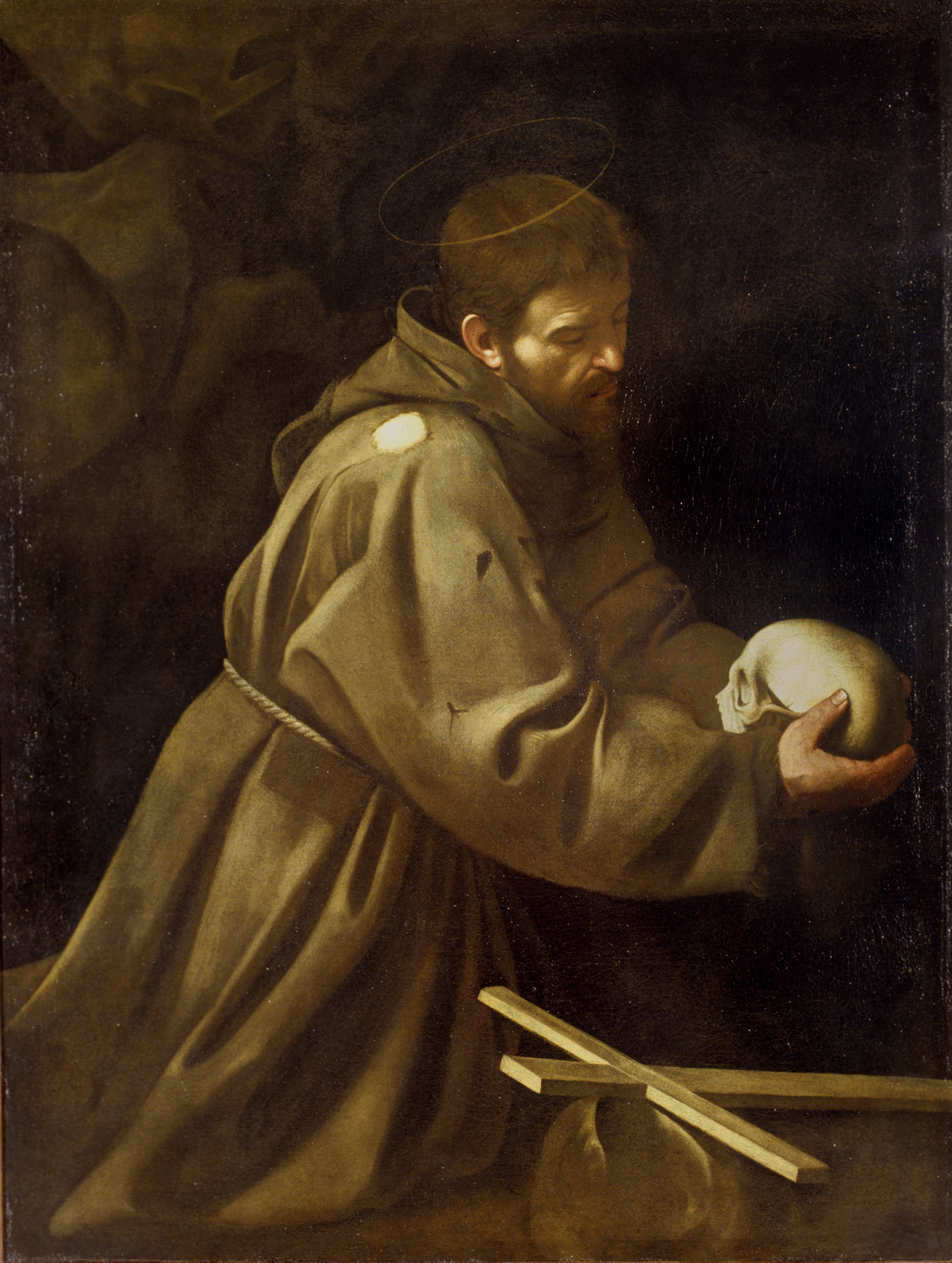
1603-04 St Francis in Prayer
oil on canvas 130 x 98 cm
Galleria Nazionale d'Arte Antica, Rome
 

St. Francis's life of poverty and humility was a popular subject in Caravaggio's age. Peter Robb makes the point that St. Francis of Assisi, together with John the Baptist and St. Jerome, "...make up the trio of alienated males, young, mature and old, brooding and remote from human society, that M (i.e. Caravaggio) painted again and again", becoming, in effect, private icons for Caravaggio's own troubled life.

In the course of a libel trial in 1603 Caravaggio's friend Orazio Gentileschi stated that he had lent the artist a monk's robe several months before, and this painting could be connected. Gentileschi's evidence seems to be the main argument behind a 1602/1604 date; but Robb, on the grounds of the austere approach and less painterly technique of the work, believes that it may date from 1606, when Caravaggio had fled Rome as an outlaw following a death in a street brawl.


1603-06 The Calling of Saints Peter and Andrew
 oil on canvas 140.1 x 176 cm
The Royal Collection, UK

A beardless Jesus gestures Peter (who was still called Simon at the time) and his brother Andrew to follow him: “Come ye after me, and I will make you to become fishers of men.”

According to the gospel Peter and Andrew were out fishing on a lake when they were called, Caravaggio gives his own interpretation. Because of his prominence, the man on the left is thought to be Peter.

It is only since 2006 that it has been attributed to Caravaggio. It was thought to be a copy of the lost original. A thorough cleaning operation revealed new details that pointed to the Italian master. The work was acquired by the English king Charles I in 1637; it was the discovery of the bill of sale that led historians to this painting in the Royal Collection.


c1603 Sacrifice of Isaac
oil on canvas 104 x 135 cm
Uffizi Gallery, Florence

The painting depicts the sacrifice of Isaac by Abraham as written in Genesis 22, with some artistic variations. In Caravaggio's version, Abraham prepares to kill his son under God's guidance by knife—rather than fire—but is rescued just in time by an angel on the left. The use of light and shadow draws attention to Abraham's right hand and his pointed blade, with the three subjects surrounding in a well orchestrated radial position. 

Posthumous identification has found that Abraham was modelled by Cecco Boneri—frequently depicted by Caravaggio—and Isaac is modelled by the same child as in his famed painting The Amor (1602). This reliance on models gives the painting an aura of authenticity, particularly regarding the angel whose wings are the only indication of a spiritual nature

c1603 Still Life with Fruit (on a stone ledge)
oil on canvas 105 x 84 cm
Denver Art Museum, Colorado

This painting is one of just a few still life artworks produced by Caravaggio. It  has been variously dated between 1601 and 1610 (Caravaggio scholar John T. Spike lists the date as circa 1603 in the second revised edition[1] of his study of the artist). It depicts a wicker basket heaped with various fruit and vegetables sitting on a stone table, caught in Caravaggio's usual strong yet mellow shaft of light falling from top left, "as if through a hole in the ceiling." (Caravaggio at around this time was sued by a landlady for having cut a hole in the ceiling of the rooms he rented, presumably to create his characteristic lighting). The bulk of the space is taken up by the large melons, marrows and pumpkins, the watermelon and pumpkin cut open to display the interior, the marrows, long and twisting, seeming to wish to escape the two-dimensional space of the picture plane.

1604 Saint John the Baptist in the Wilderness
oil on canvas 172.7 x 132 cm
Nelson-Atkins Museum of Art, Kansas City, Missouri

In this Saint John the Baptist, Caravaggio has traded idealism for what oftentimes became in his own time a controversial realism. He has literally stripped the Baptist of nearly all traditional attributes (halo, lamb and banderole inscribed Ecce Agnus Dei or Behold the Lamb of God) leaving the brooding intensity of the saint's emotional state as the subject of the painting. Saint John's solemn pensiveness is reinforced by a Caravaggio trademark: the dramatic contrast of deep, opaque shadows, playing across his body and shrouding the sockets of his eyes, with a bright light that illuminates the Baptist from above and to his right. This stark contrast of light and darkness, the brilliant scarlet of the saint's cloak and Caravaggio's placement of him in the foreground, close to our own space, all contribute to the dramatic impact of the painting. Evidence of Caravaggio's working method, in which he incised lines into the gesso ground to guide his hand while painting, can be easily seen along the sitter's left leg in the right corner. Caravaggio most likely borrowed the Baptist's pose from one of Michaelangelo’s seated prophets and sibyls on the ceiling of the Sistine Chapel in the Vatican, Rome.

1604-06 Madonna of Loreto
oil on canvas 250 x 150 cm
Basilica of St. Augustine in Campo Marzio, Rome

The painting depicts the apparition of the barefoot Virgim and naked child to two peasants on a pilgri;mage or, as some say, it is the quickening of the iconic statue of the Virgin. In 1603 the heirs of marquis Ermete Cavalletti, who had died on 21 July 1602, commissioned for the decoration of a family chapel, a painting on the theme of the Madonna of Loreto. Putting into practice the marquis's will, the Cavaletti's on 4 September 1603 purchased a chapel in the church of Sant'Agostino in Rome.

The painter Giovanni Baglione, a competitor who had successfully ensured Caravaggio was jailed during a libel trial, said that the unveiling of this painting "caused the common people to make a great cackle (schiamazzo) over it". The uproar was not surprising. The Virgin Mary, like her admiring pilgrims, is barefoot. The doorway or niche is not an exalted cumulus or bevy of putti, but a partly decrepit wall of flaking brick is visible. Only the merest halo sanctifies her and the baby. While beautiful, the Virgin Mary could be any woman, emerging from the night shadows.


1605 Ecce Homo
oil on canvas 128 x 103 cm
Palazzo Bianco, Genoa, Italyjpg

Ecce Homo (c. 1605/6 or 1609 according to John Gash.) Contemporary accounts claim the piece was part of an unannounced competition between three artists, and that the Caravaggio version was eventually sent to Spain.

According to Giambatista Cardi, nephew of the Florentine artist Cigoli, Cardinal Massimo Massimi commissioned paintings on the theme of Ecce Homo from three artists, Cigoli, Caravaggio, and Domenico Passignano, without informing the artists of the multiple commissions. Cardi claimed the cardinal preferred Cigoli's version. The Passignano painting has never resurfaced.

The scene is taken from the Gospel of John - Pontius Pilate displays Christ to the crowd with the words, "Ecce homo!" ("Behold the man”). Caravaggio's version of the scene combined Pilate's display with the earlier moment of Christ, already crowned with thorns, mockingly robed like a king by his tormentors. Massimi already possessed a Crowning with Thorns by Caravaggio (thought to be the Crowning with Thorns in Prato) and Ecce Homo may have been intended as a companion piece. Stylistically, the painting displays characteristics of Caravaggio's mature Roman-period style. The forms are visible close-up and modelled by dramatic light, the absence of depth or background, and the psychological realism of, the torturer, who seems to mix sadism with pity. Pilate, in keeping with tradition, is shown as a rather neutral and perhaps almost sympathetic figure. He is also depicted wearing anachronistic clothing which was more contemporary to Caravaggio's time.

1607-08 St. John the Baptist at the Well

This painting does not fit into the artist’s series of other St. John the Baptist works.

Only a few experts accept it as a genuine Caravaggio. Its colours are muted. A banner with writing on it, which is wound around the unusually well-defined Jacob’s Staff on the ground, has an inscription which, although the artist twists it skilfully. Can easily be read as: Agnus Dei, the Lamb of God. The painting possibly represents a late phase in the artist’s creative works. Jesus replied “Because you have seen me, you have believed: blessed are those who have not seen and yet have believed.”


1605 Madonna of the Rosary
oil on canvas 364.4 x 249.5 cm
Kunsthistorisches Museum, Vienna

The painting depicts Madonna holding on to the child Jesus surrounded by viewers. St Peter the martyr can be seen acting as a mediator, the picture shows his wounded head.

He points towards the presence of a crowned Madonna with the child Jesus. Madonna, on the other hand, turns towards St Dominic who is looking up to the people to dispense the rosaries to the people closing up space towards him on their knees. The Painting shows Mary playing the role of a mediator as the Boy Jesus is the focus of attention from both composition and content.

This painting differs from convention; there are poor barefoot men with dirty feet, and hands raised up trying to reach up to a single rosary that St Dominic is holding. A red drape frames the painting as Madonna and the child Jesus looks down the poor but faithful crowd. A Bleeding St Peter depicts his death caused violently by an axe blow from to his head, while a hooded member of Dominican order stands next to him.


1605-06 Saint Jerome in his Study
oil on canvas 112 x 157 cm
Galleria Borghese. Rome

1605-06 Death of the Virgin Mary
oil on canvas 369 x 245 cm
Louvre Museum, Paris

When he painted the Death of the Virgin, Caravaggio had been working in Rome for fifteen years. The painting was commissioned by Laerzio Cherubini. a papal lawyer, for his chapel in the Carmelite church of Santa Maria della Scala in Trastevere, Rome; the painting could not have been finished before 1605–06. The depiction of the Death of the Virgin caused a contemporary stir, and was rejected as unfit by the parish.

Giulio Mancini thought Caravaggio modelled a prostitute, possibly his mistress, as the Virgin, Giovanni Baglione and Gian Pietro Bellori attributed the rejection to the appearance of the Virgin. The breach of decorum led to a rejection of the painting by the fathers of Santa Maria della Scala and its replacement by a picture by Carlo Saraceni, a close follower of Caravaggio.


c1612 The Dormition of the Virgin by Carlo Saraceni
oil on canvas 305.1 x 231.1 cm
Metropolitan Museum of Art, New York