Tuesday, 1 February 2011

Adolph Gottlieb

More photography in the next post, but first another Abstract Expressionist. In my last post, on Milton Avery, I mentioned that Avery was a friend of Adolph Gottlieb. Gottlieb (1903 – 1973) was born in New York and left high school in 1920 to work at odd jobs while taking night classes at the Art Students League with John Sloan and Robert Henri. Through these painters, Gottlieb learned of the revolutionary breakthroughs in European painting. After a disappointing trip to Paris, where he met none of the French artists he had heard about, he returned to the United States to finish high school and continue painting. By the mid-thirties, Gottlieb was exhibiting regularly with ‘The Ten’, a New York group of avant-garde painters. In 1937 he moved to a small community outside Tucson, Arizona with his wife Esther.

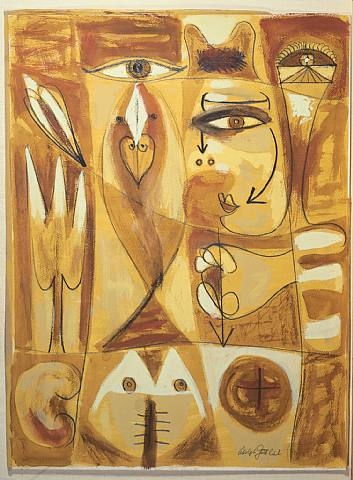
In Arizona, his subject matter changed as he became concerned with the natural forms that would continue to mark all of his subsequent work. A feeling of isolation prompted his return to New York in 1939 and from there he went to Gloucester where he began to paint beach still-lives in three-dimensional boxes set against deeply receding spaces. He soon abandoned this form, but these experiments led to his pictographs of the forties-stylized motifs based on human and natural forms isolated in compartments. For Gottlieb the pictographs were his adaptation of Surrealist automatism-the result of free association. Later, he would reduce these pictographs to an increasingly basic structure: the grid. The next step occurred in a painting divided into two parts: in the lower section he placed the interwoven lines of a grid; on top of this he drew a horizon line above which floated five areas of colour in varying geometric shapes. This was the first of a series to be known as ‘Imaginary Landscapes’.


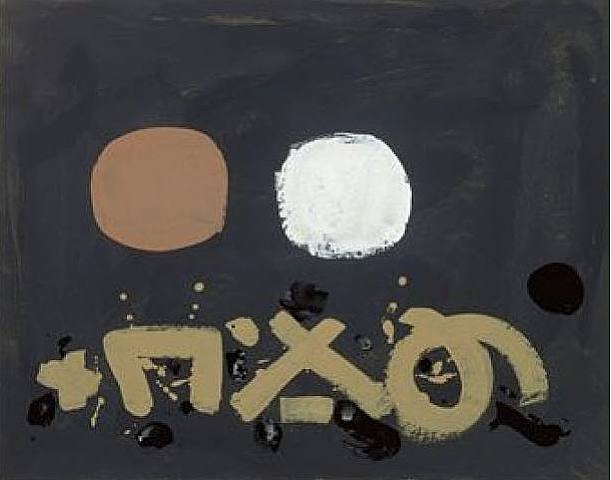
Over the years, Gottlieb's canvases became increasingly monumental in size while the images grew simpler. In 1957 the rigid format of the Landscapes dissolved into the fluid space of the ‘Bursts’ in which two images are contrasted: a peaceful sun-like disc above, and an angry ball of undifferentiated matter below.

As Gottlieb's structures became simpler he became increasingly concerned with the intensity, nuance and feeling inherent in the juxtaposition of colour.

Gottlieb spent the last part of his life in East Hampton, Long Island, amid the natural things that gave him the greatest inspiration. He suffered from paralysis during the last years of his life and died in 1973.


1937 The Natural Swimming Pool

 1938 Untitled (Arizona Still Life)


 1943 Black Hand


1945 Sailor's Charm

 1945 The Alchemist


1946 Night Voyage

 1947 Untitled


 1948 Figures


1948 Sounds in the Night

 1949 Untitled F3


1950 Labyrinth No.2

 1950 Night Forms


 1951 Sentinel


1952 Eclipse


1952 Flotsam at Noon (Imaginary Landscape)


 1956 From Midnight to Dawn


 1956 Untitled (5633)


1958 Ascension

1960 Black Plus White

1962 Blues

1966 Notations

1967 (Untitled) gouache on paper

 1967 Figure Eight


 1967 Jetsam


 1967 Mood


1967 Red Halo acrylic on paper

 1967 Untitled


 1968 Untitled


1969 Green Dream serigraph


1969 Imaginary Landscape

1969 Three Discs on Chrome Ground

1971 Blues on Green screenprint


 1971 Imaginary Landscape II aquatint


1973 Burst

 1973 Calligraphy (7315)


 1973 Untitled


 1973 Untitled

Sunday, 30 January 2011

Milton Avery

There’s more photography to come, but in order that my blog posts don’t become monotonous I am going to mix it up with some features on mid-century painters. I’m intending to look at some of the artists associated with Abstract Expressionism, followed by artists (sometimes erroneously) associated with Pop Art.
And in no particular order…I’m starting with Milton Avery, mainly because his colourful semi-abstracted landscapes are in the same area that I’m currently working in, albeit in a very different style.

Milton Avery (1893 – 1965) was born at Sand Bank, New York. After studying for a while at the Connecticut League of Art Students in Hartford under Charles Noel Flagg and at the Art Society School there under Albertus Jones, Avery worked in manufacturing and with an insurance company until 1924. He moved to New York in 1925 and married the artist Sally Michel, an illustrator, a year later.

He had his first one-man show as early as 1928 at the Opportunity Gallery in New York. The decades that followed saw him show work at numerous exhibitions mounted by New York galleries and American museums. Milton Avery's preoccupation with French Fauvism and German Expressionism led him to develop a simplified formal idiom distinguished by clarity of line and an expressive palette. Whereas Avery's early figurative drawings and paintings from the 1930s attest to affinities primarily with the work of Ernst Ludwig Kirchner, by the 1940s he was discernibly close to Henri Matisse.

As the American upholder of Matisse's colouristic doctrine, Milton Avery developed the French artist's decorative colour surfaces into subtly toned colour zones, thus breaking the ground for the Colour Field painting of Mark Rothko (see blog post July 2010) and Adolph Gottlieb (blog post to come), both of whom were friends of his. Even though his style was close to abstraction, Milton Avery nonetheless clung to representation throughout his entire career. Classical motifs and subject matter in portraits, still lifes and coastal landscapes were his main thematic areas and genres.
Prolific as a painter, graphic artist and ceramist, Milton Avery received numerous awards from American art institutions before he died in 1965 although he only really became famous posthumously. He is now acclaimed as one of the most influential American C20th artists.

1930 The Artist's Wife

 1936 Vermont Hills


 1940 Gaspe - Pink Sky

1942 Woman Drawing

1943 Landscape

 1944 Autumn


 1944 Bridge to the Sea

1944 Sketching by the Sea

1945 Girl in Scarf

1945 Spring in Vermont

 1945 Three Cows on Hillside

1946 Homework

1947 Oregon Coast

1950 March and Sally Outdoors

1951 Clear Cut Landscape

 1952 Breaking Sea


 1952 Shapes of Spring


 1953 Advancing Sea

1953 Dancing Trees

 1953 Excursion on the Thames


 1954 Green Sea


 1954 White Wave


 1955 Spring Brook

1957 Birds Over Sea

 1957 White Moon


 1958 Green Sea


 1958 Offshore Island


 1958 Onrushing Wave


 1958 Sea Grasses and Blue Sea

Yellow Sky

 1959 Black Sea


 1959 Boathouse by the Sea

1959 Gull + Sea

1960 Interlude

 1961 Blue Bay and Dunes

Gaspé Landscape

Beach Study

Two Chickens

White Rooster