Monday, 21 March 2011

Robert Rauschenberg

After looking at the work of Jasper Johns I thought it appropriate to take a look at the work of another ‘founding father’ of pop art, Robert Rauschenberg (1925 – 2008). I mentioned that in 1954 Jasper Johns had met the artist Rauschenberg when together they decorated the shop window of Tiffany’s. They became lovers, and Rauschenberg soon had great influence on Johns’ own work.

Rauschenberg was both a painter and a sculptor but he also worked with photography, printmaking, papermaking, and performance art.

By the mid 1950s, Rauschenberg was making the wild assemblages and collaged multimedia works in which non-traditional materials and objects were employed in innovative combinations. These ‘Combines’ as they were known, are my personal favourites amongst his works – it’s possible to see ideas and elements emerging that would later influence artists like David Hockney and Peter Blake in their formative years.

In 1955 he moved into a studio in the same neighborhood as Jasper Johns. In 1958 he had his first exhibition at the Leo Castelli gallery
In 1959 he was represented at the documenta 2, Kassel, and at the Paris and São Paulo Biennales.
In 1962 he first used the technique of silkscreen on canvas, mixed with painting, collage and affixed objects. In 1963 he was given his first retrospective exhibition in Europe at the Galerie Sonnabend, Paris, also shown at the Jewish Museum, New York. In 1964 he had a retrospective at the Whitechapel Gallery, London, and won the Grand Prix at the Venice Biennale.

By the 1970s, Rauschenberg began his now signature procedure of building visual fields from collisions of appropriated media images: snippets from magazines, newspapers and trashy pulp fiction - silk-screened and manipulated to blend and battle on fabric, canvas, metal and glass, you name it.
Rauschenberg’s work gave new meaning to sculpture. Canyon for instance, consisted of a stuffed bald eagle attached to a canvas. Monogram was a stuffed goat girdled by a tyre sitting on a painted panel. Bed entailed a quilt, sheet and pillow, covered in paint. All became icons of post-war modernism.

1959 Canyon


1955-1959 Monogram (freestanding combine)


Rauschenberg once said “I really feel sorry for people who think things like soap dishes or mirrors or Coke bottles are ugly, because they’re surrounded by things like that all day long, and it must make them miserable.”

A large retrospective of his work was shown in several American cities from 1976-78. In 1980 he had retrospectives at Berlin, Düsseldorf, Copenhagen, Frankfurt, Munich and London. In 1981 his photographs were shown at the Pompidou Centre in Paris. He was awarded the National Medal of Arts in 1993.

Robert Rauschenberg died aged 82 at his home on Captiva Island, Florida, in 2008.

 1950 Pilgrim


 1954 Charlene (combine)


 1954 Collection


 1954 Minutiae (freestanding combine)


 1955 Bed (combine painting)


 1955 Hymnal (combine)


 1955 Interview (combine)


1955 Rebus


 1955 Untitled (combine)


 1956 Small Rebus


 1957 Factum II (combine)


 1962 Brace (oil and silkscreen ink)


 1963 Estate (oil and silkscreen ink)


 1963 Tracer (oil and silkscreen ink)


 1963 Untitled (combine)


 1964 Harbour (oil and silkscreen ink)


 1964 Retroactive I (oil and silkscreen ink)

Note: A number of images have been removed by me from this post on possible copyright issues. Poul Webb

Saturday, 19 March 2011

Jasper Johns

One of the ‘founding fathers’ of pop art, Jasper Johns was born in Augusta, Georgia in 1930. In 1947- 48 he studied art at the University of South Carolina, but soon moved to New York where he did an apprenticeship as a commercial artist. In 1951-52 he had to serve his time in the army. Back in New York he earned a living doing odd jobs.

In 1954 Johns met the artist Robert Rauschenberg when together they decorated the shop window of Tiffany’s. They became lovers, and Rauschenberg soon had great influence on Johns’ own work. In the 1950s he makes the first ‘Flag’, ‘Target’, and ‘Number’ artworks. In 1958 his first one-man show was held at the Leo Castelli gallery in New York.

Works from those days are dominated by the motif of the American flag and the target, but also numbers and letters, the images that Johns is most famous for. Like Rauschenberg, Johns picks the issue of the ambiguity of symbols in a consumer society as the central motif of his work - symbols that are deprived of their symbolic function by their daily reproduction by mass media. Johns soon began to use the ancient technique of encaustic, which he applied to his newspaper collages.

He is best known for his painting Flag (1954-55) which he painted after having a dream about the American flag. His work is often described as a Neo-Dadaist, as opposed to Pop Art, even though his subject matter often includes images and objects from popular culture. Still, most compilations on Pop Art include Jasper Johns because of his artistic use of classical iconography.


1954-55 Flag


Detail of Flag 1954-55 showing use of encaustic (the use of hot wax), oil, and collage on fabric mounted on plywood (three panels). Now in the Museum of Modern Art, New York.

In the late 1950s he also worked on sculptures, casting and painting everyday banal objects like beer cans or light bulbs. In the 1960s he made assemblages, integrating real objects or casts of body parts into his panels. His range of elements expanded over the following year, his works become more and more complex and, full of details alluding to private events or art history.

In 1988 he was awarded the Grand Prize for Painting at the Venice Biennale. In 1989 he was appointed honorary member of the Royal Academy in London. The Museum of Modern Art in New York held a large retrospective in 1996.

Footnote: In 1999, Jasper Johns guest-starred in the animated television series The Simpsons, as himself. In the episode “Mom and Pop Art”, Homer Simpson is hailed as an “outsider artist” after an art dealer discovers Homer's mangled brick barbecue grill, and Johns attends one of his exhibitions. Johns is portrayed as a kleptomaniac, constantly stealing food items, lightbulbs, a motorboat, and Marge’s painting of the flooded town.


 1955 Target with Four Faces 

Jasper Johns and Robert Rauschenberg both incorporated images taken from popular culture into a fine art context, and English pop artist Peter Blake has acknowledged their example. This work refers to Johns's work in particular. Whereas Johns had taken a familiar object - a target - and executed this motif on the canvas in a painterly style, Blake took this further by using a real archery target purchased from a sports shop. The work of art is consequently less like a painting and is even closer to the real world. Blake thus questions: is this 'The First Real Target'?


 Peter Blake: The First Real Target? 1961


 1956 Grey Alphabets


1958 Three Flags


1959 False Start

 1960 Painting with Two Balls


 1960 Painted bronze (Ballantine Ale)


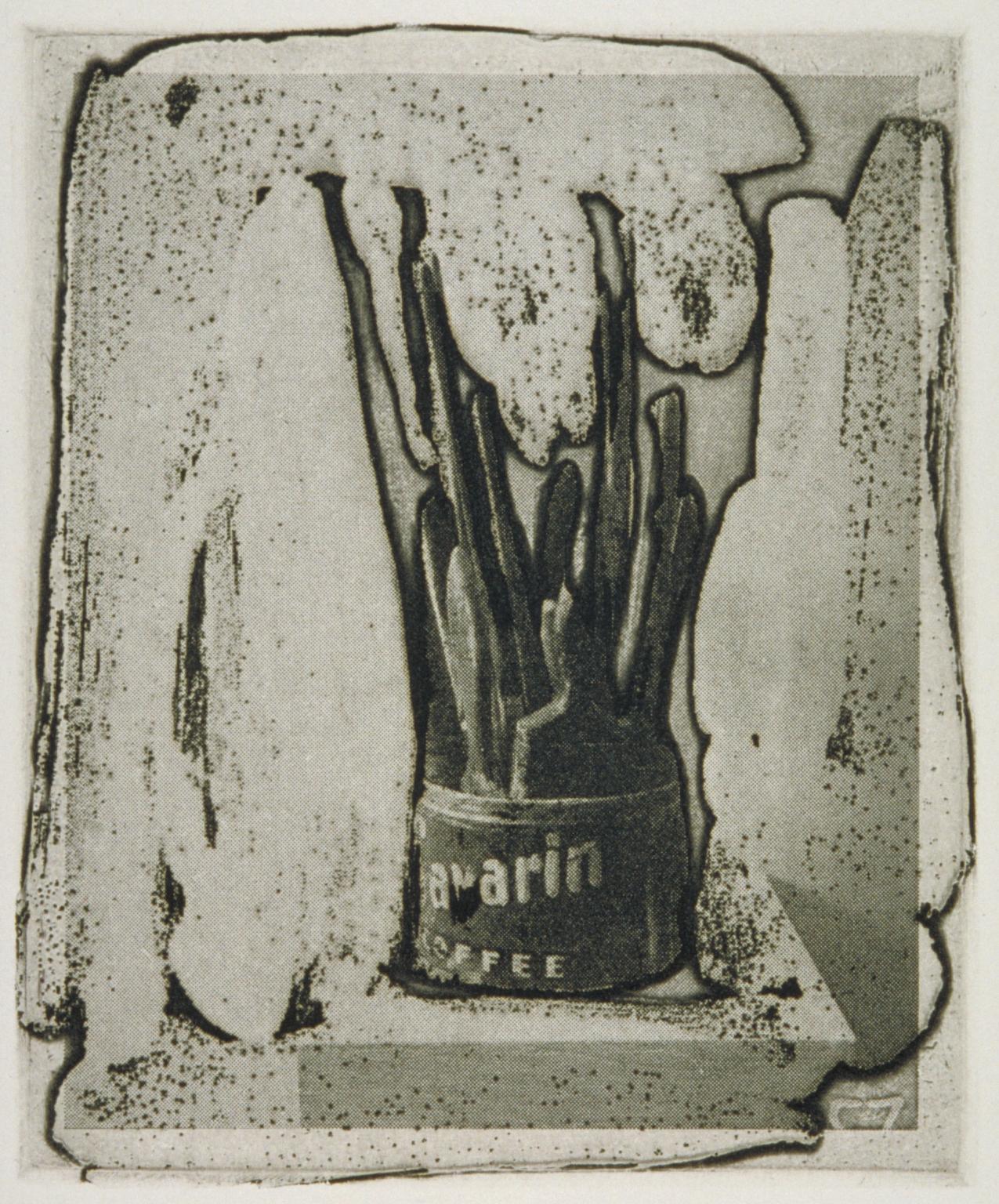
 1960 Painted bronze (Savarin Coffee)


1967-69 Untitled

1967-69 Untitled 
1977-81 Savarin

1978 Savarin

1978 Savarin

1982 Savarin


1961 0 - 9

1961 0 - 9

1961 Map

1961 Target


 1962 Fools House


1963 0-9: Plate 8


 1964 Souvenir


 1964 Watchman


1967 Corpse and Mirror

1967 Flag

1967 Watchman

1967-69 Title Page

1967-69 Untitled


1969 Figure 7

1968 Figure 9


1969 Figure 9

1970-71 Sketch for Cups 2 Picasso / Cups 4 Picasso

1970-72 Two Flags (black)

1971 Decoy

1972 Evian

1972 Four Panels from Untitled

1972 Zone

 Scent 1973-4


1977 Untitled

1978 Land's End

1979 Cicada

 Dancers on a Plane 1979


1980 Untitled

1980 Usuyuki

1980-81 Dancers on a Plane

1981 Cicada

1982 Between the Clock and the Bed

 1982 In the Studio


 1984 Racing Thoughts


1984 Untitled

1986 Ventriloquist 
1987 The Seasons (Spring)

1987 The Seasons (Summer)

1987 The Seasons (Fall)

1987 The Seasons (Winter)

1989 The Seasons

 Green Angel 1990


1991 Untitled

1992 Untitled

1992 Untitled

1992 Untitled

1994 After Holbein

1994 Untitled

2004 Pyre

2005 Bushbaby

2007 Within

2008 0-9 aluminium

2011 Shrink Dink 3

2011 Shrink Dink 4

2012 Untitled

2014 Regrets