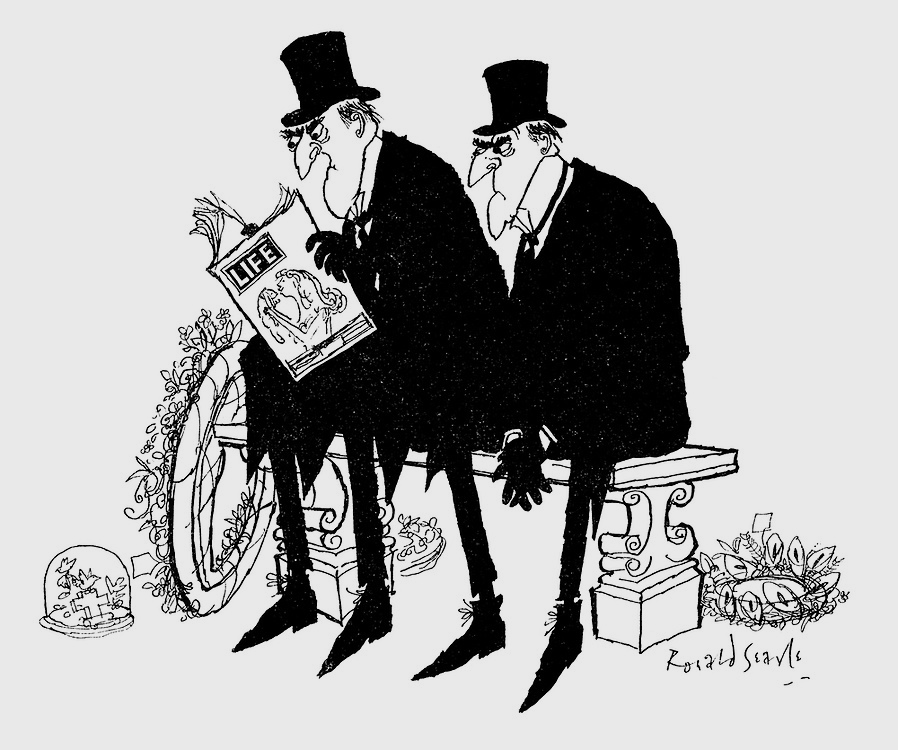
The son of a railwayman, Ronald Searle was born in Cambridge on 3 March 1920, and educated in the town at the Boys' Central School. He started work as a solicitor's clerk, and then joined the hire purchase department of the co-operative Society, studying in the evenings and later full-time at the Cambridge Daily News from the age of fifteen.
Enlisting in the Royal Engineers at the outbreak of the Second World War, he spent time in Kirkcudbright, where he encountered evacuees from St. Trinian's, a progressive girls' school situated in Edinburgh.
This resulted in his first cartoon for Lilliput, published in October 1941, and later developed into one of his most famous creations, through a series of books and their cinematic spin-offs. Remarkably, he survived the horrific experiences of the Changi Camp, Singapore as a Japanese prisoner-of-war and managed to produce a visual record of life in a prison camp.
On his return to England in 1945, he exhibited the surviving pictures at the Cambridge School of Art, and published Forty Drawings. The exhibition and volume together established his reputation as one of Britain's most powerful draughtsmen, and led to several opportunities to record the atmosphere of post-war Europe. He contributed to Punch and these drawings crystallised in, The Female Approach (1949). Throughout the fifties, he produced a large variety of illustrations, which together seemed present a guide to life in Britain in the 1950's.
Such was his success that his rejection of family and country in a move to Paris in 1961 came as a great surprise. However, it offered a fresh start, resulting in several solo shows, including a major exhibitions at the Bibliotheque Nationale, Paris, the Berlin-Dahlem Museum and the Wilhelm-Busch-Museum, Hanover. He also reached a new audience with his contributions to film and television, most notably The Magnificent Men in their Flying Machines (1965).
Note: Searle did so many works that I want to post here, that I will post them in two separate series: 1940-1960, and at a later date: 1961-2007.
For a more detailed biography see part 1, and for earlier works, see parts 1 - 10 also.
This is part 11 of a 13-part series on the works of Ronald Searle, dated 1940-1960:
1958 The Big City or the New Mayhew by Alex Atkinson & Ronald Searle published by Perpetua Books:
 |
| Front and Back Covers |
 |
| Front Cover |
 |
| Racing Dogs pen and ink on paper Wilhelm Busch – Deutsches Museum für Karikatur und Zeichenkunst © The Ronalad Searle Cultural Trust |
 |
| Income Tax Man pen and ink on paper |
 |
| Literary Man pen and ink on paper Wilhelm Busch – Deutsches Museum für Karikatur und Zeichenkunst © The Ronalad Searle Cultural Trust |
 |
| "O" Initial A Bohemian Soiree pen and ink on paper Wilhelm Busch – Deutsches Museum für Karikatur und Zeichenkunst © The Ronalad Searle Cultural Trust |
 |
| "Q" Initial pen and ink on paper A Literary Man Wilhelm Busch – Deutsches Museum für Karikatur und Zeichenkunst © The Ronalad Searle Cultural Trust |
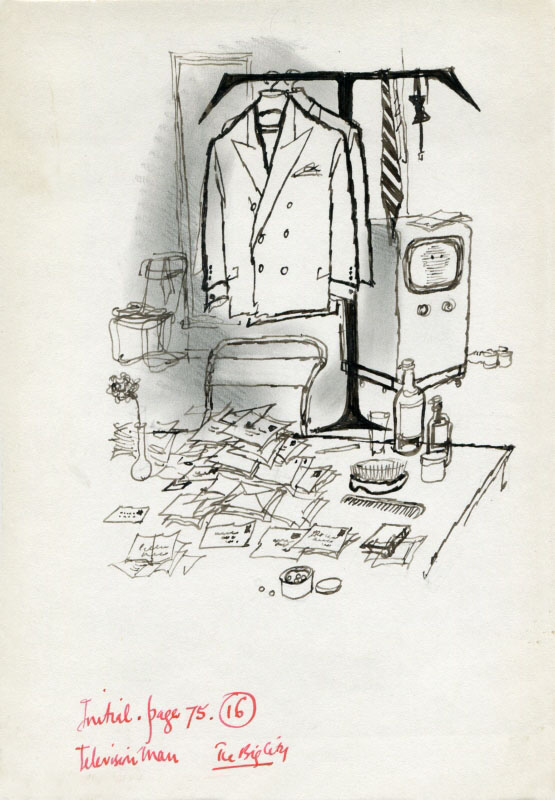 |
| "T" Initial letter pen and ink on paper Television Man Wilhelm Busch – Deutsches Museum für Karikatur und Zeichenkunst © The Ronalad Searle Cultural Trust |
 |
| Pen and ink on paper |
 |
| Pen and ink on paper |
 |
| Pen and ink on paper |
 |
| Pen and ink on paper |
 |
| Pen and ink on paper |
 |
| Pen and ink on paper |
 |
| Pen and ink on paper |
1959-60 Refugees:
 |
| 1959 Camp Laschenskyhof, Salzburg 39 x 56 cm Wilhelm Busch - German Museum of Caricature and Drawing |
 |
| 1959 Food Queue, Aversa Refugee Camp Near Naples, 14. November 1959 38.3 x 54.5 cm Punch magazine Wilhelm Busch - German Museum of Caricature and Drawing |
 |
| 1959 Russian Farmer & Daughter, Asten Refugee Camp Austria, 5. November 1959 39.2 x 54.1 cm Wilhelm Busch - German Museum of Caricature and Drawing |
 |
| Refugees 1960 published by Penguin Books, London |
 |
| 1956 Nigel's B-Line is the sensation of the Season pen and ink 17.5 x 16 cm |
 |
| from Punch magazine |
 |
| from Punch magazine |
 |
| c1956 Such is Life: Al Read and Jack Tripp for Punch magazine |
 |
| 1956 Winston Churchill Punch magazine |
 |
| 1956 Young Elizabethan magazine August issue |
 |
| 1956 Young Elizabethan magazine June issue |
 |
| 1956 Young Elizabethan magazine October issue |
 |
| 1957 "Of course, you're lucky - yours curls naturally." Punch magazine |
 |
| 1957 Holiday magazine November issue "Spendthrift Tour of New York" |
 |
| 1957 La Signora Della Torre by John Symonds Italian cover |
 |
| 1957 My Uncle Harry by Geoffrey Willans published by Parrish |
 |
| 1857 Paris |
 |
| 1957 Punch magazine cover |
 |
| 1957 Un alligatore che si chiama Margherita by Charles Terrot published by Longanesi & C. |
 |
| 1957 Young Elizabethan magazine April issue |
 |
| 1958 Charles de Gaulle as Don Quixote published in Punch magazine Wilhelm Busch – Deutsches Museum für Karikatur und Zeichenkunst © The Ronalad Searle Cultural Trust |
 |
| 1958 Fernandel Punch magazine 21 January 1959 |
 |
| 1958 Of Mice and Men & Cannery Row Penguin Books cover |
 |
| 1958 Punch magazine cover July 23 issue |
 |
| 1958 Punch magazine cover |
 |
| 1958 The Dog's Ear Book by Geoffrey Willans & Ronald Searle published by Thomas Crowell & Co. |
 |
| 1958 The Dog's Ear Book title page pen and ink 26.7 x 20.3 cm |
 |
| 1958 The Dog's Ear Book "I beg your pardon…" pen and ink and watercolour 15.9 x 24.2 cm |
 |
| 1958 The Gay Twenties - A Decade of Theatre by J.C. Trewin, Raymond Mander & Joe Mitchenson cover by Ronald Searle |
 |
| 1958 To My Astonishment by Diana Graves published by Arthur Barker, London |