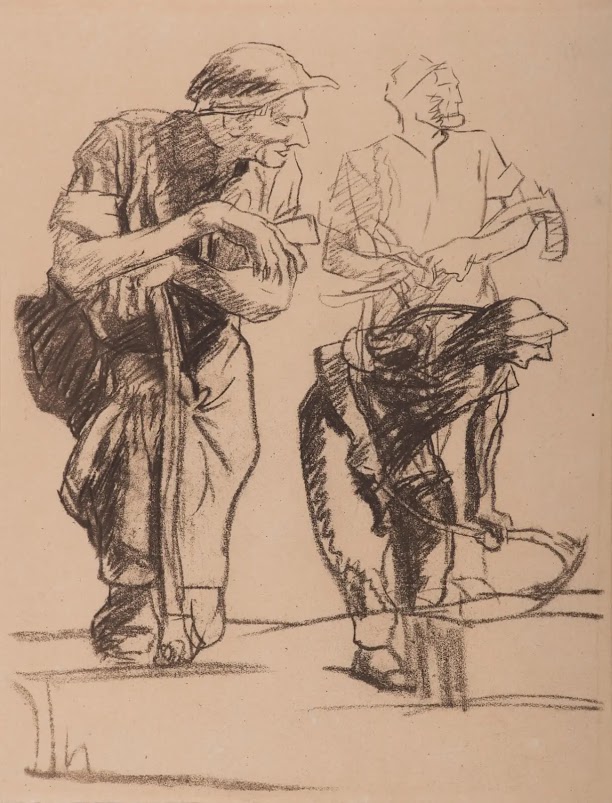
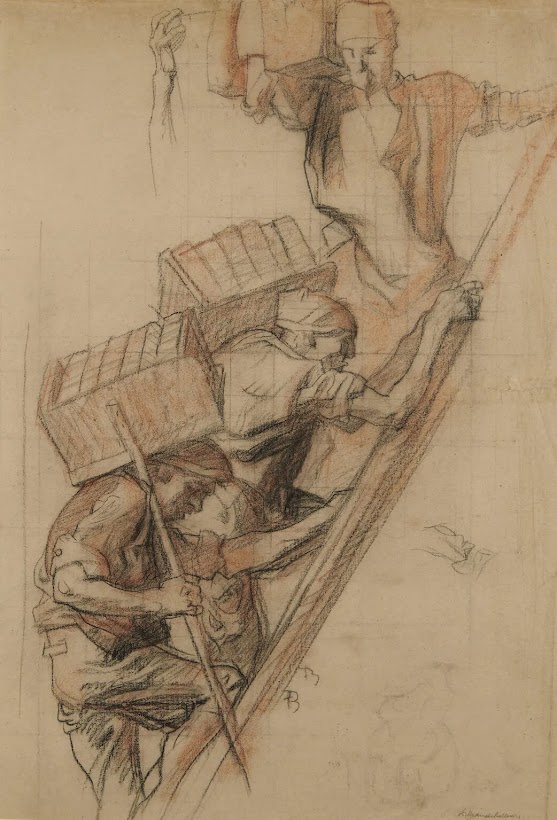
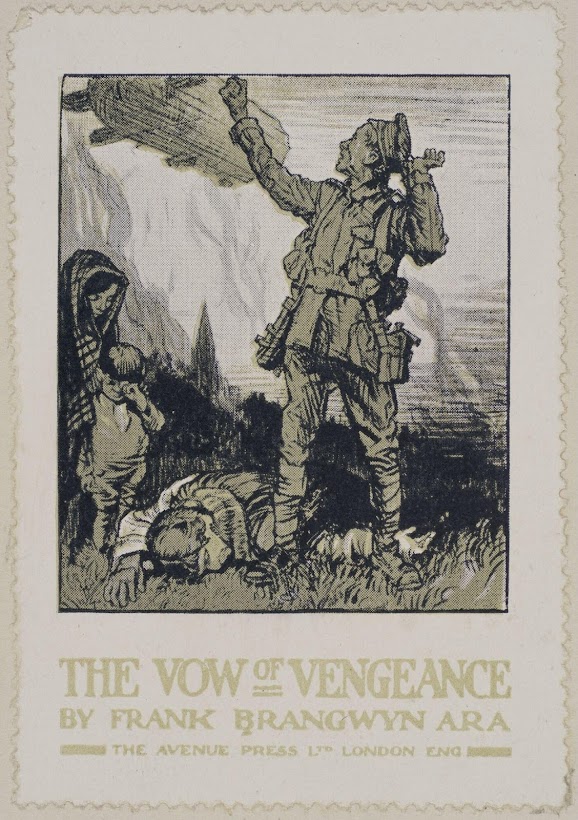
Frank Brangwyn (b. Bruges, 13 May 1867: d. Ditchling, Sussex, 11 June 1956) was a British painter, printmaker, draughtsman, and designer, the son of a Welsh architect who specialised in church furnishings, and who was working in Belgium at the time of Frank’s birth. Between 1882–84 he served an apprenticeship with William Morris, and like his master he was active in a variety of fields. He was an Official War Artist during the First World War, and was considered one of the finest draughtsmen of the day; a skilful etcher and lithographer, who also made designs for a great range of objects (furniture, textiles, ceramics, glassware, and jewellery) however, he became best known for his murals. His most famous undertaking in this field was a series of large panels on the theme of the British empire, commissioned by the House of Lords.
All images © Estate of Sir Frank William Brangwyn.
This is part 5 of a 10-part series on the works of Frank Brangwyn:
c1916 Mars Appeals to Vulcan
two-colour lithograph poster 57.7 x 45.7 cm
V&A Museum, London1916 War
lithograph on paper 44.5 x 68.5 cmc1917 The Boatswain
oil on board 42 x 62 cm
Art Gallery of New South Wales, Sydney, Australiac1917 Making Sailors: Boatdrill
lithograph 54 x 38 cm1917 Wharfside, The Thames
etching on paper 33 x 45.5 cm
Christchurch Art Gallery, New Zealand1917 The Last of H.M.S. Britannia
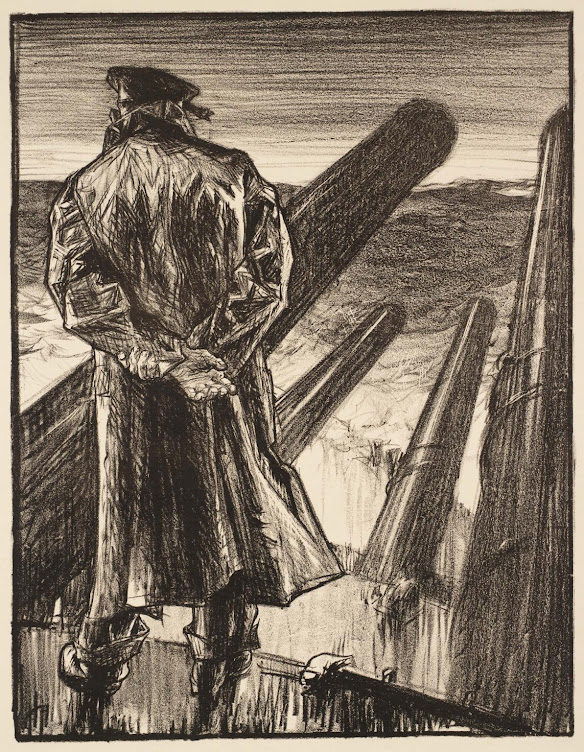
etching on paper 55 x 81 cm1917 The Gun
lithograph on paper 54.9 x 38.1 cm
National Museum Cardiff, UK1917 Demolition of the General Post Office (London)
etching on paper 64.5 x 77 cm
Danum Gallery, Library and Museum, Doncaster, UK


The lithographs were divided into two thematic categories: ‘Efforts’ and ‘Ideals.’ The 'Efforts' depicted tangible contributions to the war effort, such as Kennington’s series, "Making Soldiers," which illustrated men's progression from training to the trenches. The 'Ideals' aimed to convey the moral reasons for the conflict, with works like Brangwyn's "Making Sailors" employing a range of artistic styles from Edwardian to Modern to engage and persuade a war-weary public.
First exhibited at the Fine Art Society in July 1917, these prints toured Britain and America, raising funds for the war effort. Following the war, sales diminished and many prints were donated to public museums and galleries, including the newly formed Imperial War Museum, which later took over the project's administration after the Ministry of Information (successor to Wellington House) was disbanded following the Armistice.
 |
| Youthful Ambition lithograph on paper 45.5 x 36 cm Tate, London |
 |
| The Lookout lithograph on paper 45.8 x 35.5 cm Tate, London |
 |
| The Gun lithograph on paper 47.1 x 37.1 cm Tate, London |
 |
| The Freedom of the Seas colour lithograph on paper 50.9 x 76.3 cm Hugh Lane Gallery, Dublin |
 |
| Making Sailors - Boat Drill lithograph on paper 54 x 38 cm Imperial War Museum, London |
 |
| Duff lithograph on paper 54.3 x 38.1 cm Tate, London |
 |
| Going Abroad lithograph on paper 47 x 35.5 cm Tate, London ---------------------------------------------------- |
 |
| c1918 He Needs Your Help Now, Buy War Bonds lithograph with hand colouring 100.6 x 151.6 cm V&A Museum, London |
 |
| 1918 Put Strength in the Final Blow. Buy War Bonds lithograph on paper 151.7 x 101.6 cm V&A Museum, London |
 |
| 1918 Fashions at the Front lithograph on ivory wove paper 44 x 64.8 cm Art Institute of Chicago, IL |
 |
| 1918 Desolation on the Front lithograph on paper 91 x 138 cm |
 |
| 1919 Blacksmith woodcut on paper 10 x 3 cm |
 |
| 1919 A Venetian Procession etching and drypoint printed on yellow Japanese paper 17.9 x 25.5 cm (plate) National Gallery of Victoria, Melbourne |
 |
| by 1919 Vimy lithograph on paper 51 x 77.5 cm (sheet) Museums, Wales, UK |
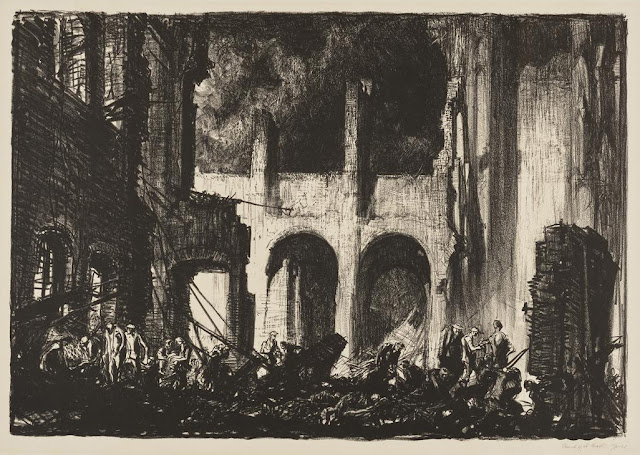 |
| by 1919 Church of St Martin, Ypres lithograph on paper 51 x 77.5 cm (sheet) Museums, Wales, UK |
 |
| by 1919 Cambrai lithograph on paper 63.3 x 80.7 cm (sheet) Museums, Wales, UK |
 |
| by 1919 Arras lithograph on paper 60.8 x 80.9 cm (sheet) Museums, Wales, UK |
 |
| 1919 Building the New Bourse, Paris etching on copper 17.3 x 17.5 cm William Morris Gallery, London |
 |
| 1919 Nativity etching, sandpaper ground on yellowed, wove paper 36.4 x 55.4 cm Queensland Art Galley of Modern Art, Brisbane, Australia |
 |
| 1919 Mask woodcut on paper 6.3 x 4.3 cm |
 |
| 1919 L'Eroica woodcut on paper 22.3 x 18.3 cm |
1919 British Empire Panels: There were 16 British Empire Panels in the original set created by Brangwyn as a contribution to the national art heritage. They are now housed in the assembly room in Swansea's Guildhall – named Brangwyn Hall.
They were begun in 1926 and rejected amid great controversy in 1930, being considered too flamboyant for their setting.
The rejection of his British Empire panels caused Brangwyn to experience a great depression after his seven years of work on the murals, however his unique depiction of the Empire – despite its complicated context in line with colonial ideology – has continued to be reproduced for decades.
Offers for the panels came from all over the world, and in 1934 they were installed in the Guildhall in Swansea. Brangwyn's work at its most characteristic was floridly coloured, crowded with detail and incident, and rather Rubensian, although it later became somewhat flatter, lighter, and more stylised. For much of his career he was one of the most famous artists in the world. He received many honours at home and abroad and was held in particularly high esteem in his birthplace Bruges, where a museum devoted to him was founded in 1936 (there is another large collection of his work in the Musée Municipale, Orange). His reputation crumbled after his death, his work tending to be dismissed as facile and sentimental, but there has recently been a revival of interest in him: a major exhibition was held in Leeds, Bruges, and Swansea in 2006 to mark the 50th anniversary of his death.
 |
| England |
 |
| Canada |
 |
| Canada |

 |
| Canada |
 |
| West Africa |
 |
| West Indies |
 |
| Siam |
 |
| Burma |
 |
| India |
 |
| India |
 |
| East Africa |
 |
| Australia |
 |
| East Indies |
 |
| East Indies |
 |
North Africa |
 |
| Panels at the rear of Brangwyn Hall |