Wednesday, 14 July 2010

Peter Blake

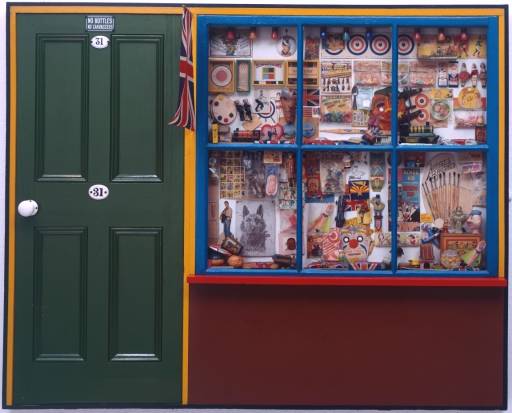
I've met Peter Blake, the Pop Artist, on a few occassions and always found him quiet, charming and enthusiastic. He is probably most famous for the most famous record sleeve ever, The Beatles' Sergeant Pepper album of 1967. I went to his house in Hither Green in 1969 and he showed me the Joe Louis figure that was on the cover and now standing amongst piles of collected material in the front room. I'm a huge fan  of his work; I bought a copy of his tinplate artwork Babe Rainbow in Carnaby Street in around 1967 and it hangs in my studio today along side an original Sergeant Pepper album and a couple of signed postcards.


Between 1946 to 1951 Peter Blake studied at Gravesend Technical College and School of Art, 1950 to 1956 at the Royal College of Art, London, 1951 to 1953 he served in the Royal Air Force. He also studied folk art in various European countries with a research award, 1959 he did collages with pin-up photos, star images, posters, LP covers and trivial images. Between 1960 and 1962 he taught at St. Martin's School of Art, London, 1962 to 1964 at the Walthamstow School of Art. In 1961 he obtained First Prize in the John Moore Exhibition, Liverpool, for Self-Portrait with Badges. In 1963 he married Jann Haworth and travelled to Los Angeles to do drawings for the Sunday Times.


In 1969 he was given his first retrospective by the City Art Gallery in Bristol. He moved to Wellow, Avon, and continued to live there until 1974. 1973 and 1974 he had retrospectives in Amsterdam, Hamburg, Brussels and Arnheim. He was made A.R.A. in 1974 and R.A. in 1981. 1974 to 1976 he taught at the Royal College of Art, London. 1975 he and his wife Jann were founding members of the Brotherhood of Ruralists, who had their first exhibition at the Royal Academy in 1976. He became separated from Jann in 1981 and returned to London. In 1983 he was given a large retrospective exhibition at the Tate Gallery and at the Kestner-Gesellschaft, Hanover.




Tuesday, 6 July 2010

Peter Max


For the last of my blogs on look-a-like illustrators of the late 1960's/70's I'm showing some work by Peter Max. Max (born Peter Max Finkelstein in 1937) is a German-born American artist best known for his iconic art style in the 1960s. Max is a multi-dimensional creative artist. He has worked with oils, acrylics, water colors, finger paints, dyes, pastels, charcoal, pen, multi-coloured pencils, etchings, engravings, animation cells, lithographs, serigraphs, silk screens, ceramics, sculpture, collage, video and computer graphics.


Peter Max was born in Berlin in 1937 but his family moved to China when he was still very young. In fact the young Max would move frequently with his family, learning about a variety of cultures throughout the world while travelling from Tibet to Africa to Israel to Europe until his family moved to the U.S.


In America Max was trained at the Art Students League, Pratt Institute, and the School of Visual Arts, all in New York. After closing his design studio in 1964, Peter began creating his characteristic paintings and graphic prints.


Max is noted for his undulating graphic designs in bright, vibrating colors. His style has greatly influenced commercial art. It is reminiscent of art nouveau and comic strip art, incorporating psychedelic colours in floral and celestial motifs.


Sunday, 4 July 2010

Heinz Edelmann

In my last blog post I looked at the work of American illustrator Seymour Chwaste, and mentioned the similarity between some of his work and that of German illustrator Heinz Edelmann (20 June 1934 – 21 July 2009).

Edelmann was actually born in Czechoslovakia in 1934. He is a well-known illustrator in Europe, but is probably most famous for his art direction and character designs for the 1968 animated film Yellow Submarine.


From 1953 to 1958 Edelmann studied printmaking at the Düsseldorf Academy of Fine Arts. He began his career as a freelance illustrator and designer for theatre posters, and German advertising. From 1961 - 1969 he was a regular illustrator and cover designer for the internationally renowned youth magazine twen. During 1967 - 1968 he worked on Yellow Submarine.


Between 1968-1970, he was a partner in a small animation company in London but his desire to work on more feature films did not come about. In 1970, Edelmann moved to Amsterdam and designed posters for plays, films and book jackets. His last deliberate use of the style of Yellow Submarine was for illustrating a book, Andromedar SR1 (1970), which was about a voyage to Mars. He also designed the cover for a German edition of Tolkien's The Lord of the Rings. Also known are his numerous illustrations for Kenneth Grahame's children's book The Wind in the Willows.


From 1972–1976, Heinz Edelmann taught industrial graphic design in the Department of Applied Sciences Duesseldorf. After that he was Lecturer of Art and Design at the Fachhochschule Köln. (Cologne factory schools) and in 1999, he became professor of illustration at the State Academy of Fine Arts in Stuttgart. Edelmann died in 2009 in Stuttgart aged 75.


Friday, 2 July 2010

Seymour Chwast

In my last blog about Tadanori Yokoo, the Japanese graphic designer and illustrator, I mentioned that one of his quoted influences was the work of Push Pin Studios in New York, particularly that of Milton Glaser and Seymour Chwaste. Over the next couple of blogs I will show a thread of connections through the work of certain illustrators.

Seymour Chwast was born in Bronx, New York on 18 August 1931 and graduated with a Bachelor of Fine Arts from Cooper Union art school in 1951. With Milton Glaser and Edward Sorel, he founded Push Pin Studios in 1954. The bi-monthly publication The Push Pin Graphic was a product of their collaboration.


These illustrations, typical of Chwaste's work will remind you of the Beatle's cartoon Yellow Submarine, which was in fact drawn by another illustrator, the German Heinz Edelmann.

Chwast is famous for his commercial artwork, which includes posters, food packaging, magazine covers, and publicity art. Often referred to as "the left-handed designer," Chwast's unique graphic design melded social commentary and a distinctive style of illustration. Today, he continues to work and is principal at The Pushpin Group in New York City.