 |
Self Portrait 1905
©The Trustees of the British Museum |
Born in Liverpool, England, the son of portrait painter Thomas Crane, Walter demonstrated remarkable talent in painting from a young age. Having been raised in an environment that strongly nurtured his talent, he was apprenticed at the age of thirteen to the eminent London wood engraver W.J. Linton. Engravers were dubbed “woodpeckers” in those days. In the daytime they worked lined up in a row in front of a window, and at night they huddled in circles at round tables with a gas lamp set in the middle. In the daytime Crane dedicated himself to learning technique, and in the evening he and the Linton’s son would go off to play hide and seek in the neighborhood chapel, or go watch the boats on the nearby river. Sometimes Walter would get young Linton to show him books. For three years he spent much time at the local zoo sketching animals, which became the basis for his later paintings.
When he was sixteen, he worked as a press artist—whose function was that of today’s photo journalist—but the emphasis on fidelity and accuracy and the need to suppress imagination and creativity were not satisfying. Crane became independent at seventeen. Gradually as form and style took precedence in his work over recreating reality for magazine illustrations, he grew into an artist with strong powers of definition and the ability to use lines to express light and shadow. Increasingly he was drawn to imaginary themes, as well as children's book illustrations, which are subject to fewer constraints imposed by the text.
In 1863 he met Edmund Evans, a young engraver who was searching for ways to do color printing. Together they broke away from the simple notion that held sway among the printers of the day that “bright colors are best for children.” He also broke new ground in his children’s books with animals as the main characters, and in the skilful way he combined the precision of the natural scientist with humour and affection. During the time of transition in the Victorian age he sought to create the best designs for children with emphasis on the child's point of view. He eventually became a leader in England’s golden age of picture books.
Crane did a number of noteworthy paintings that were heavily influenced by the Italian Renaissance of the fifteenth century, including “Love’s Sanctuary” (1870) and “The Renaissance of Venus” (1877). In 1882 he published wood engravings for “The Goose Girl,” which was published in Household Stories of the Brothers Grimm (1892), and those engravings became the basis for some of William Morris’s tapestries. Depicting a strange and illusory world that stretched beyond the borders of the illustration, the engravings became a prime example of art nouveau. Later, he joined the Arts and Crafts Movement in a quest to combine ornament and utility, or aesthetic and function. This conjunction of beauty and use was part of the essence of fin de siècle art, and Crane wrote a number of essays about the theory of the movement. A fervent socialist, he produced many works expressing his political beliefs, one of which was his May Day poster series that reflected the concerns of the English intelligentsia of the time. His influence spread well beyond England, partly through the cover illustrations he made for the German magazine Jugend.
Note: At a later date I will be posting a series on Walter Crane’s individual works.
This is part 1 of a 19-part series on the works of Walter Crane:
1865 & 1875 Sing a song of sixpence:
 |
1865 Font Cover
published by George Routledge & Sons |
 |
When the pie was open'd,
The birds began to sing
pen and brown ink with watercolour
© The Trustees of the British Museum |
 |
7 The King was in his counting-house,
Counting out his money
pen and black ink with watercolour
© The Trustees of the British Museum |
 |
The Queen was in the parlour,
Eating bread and honey
pen and black ink with watercolour
© The Trustees of the British Museum |
 |
The maid was in the garden,
Hanging out the clothes
pen and black ink 20.5 x 15.6 cm with watercolour
© The Trustees of the British Museum |
1875 The Song of Sixpence:
 |
| End-Paper |
 |
Sing a song of sixpence,
A pocket full of rye, |
 |
Four & twenty black-birds
Baked in a Pie |
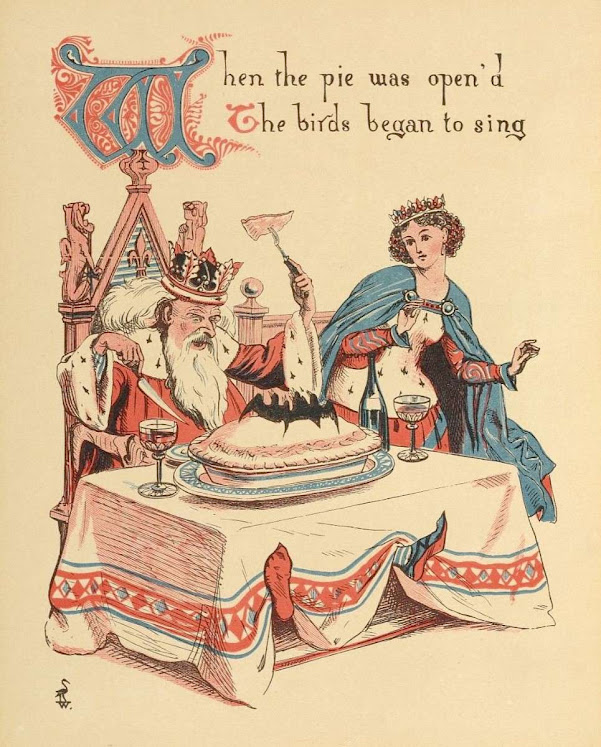 |
When the pie was open'd
The birds began to sing |
 |
The King was in his counting-house,
Counting out his money. |
 |
The Queen was in the parlour,
Eating bread and honey.
|
 |
The maid was in the garden,
Hanging out the clothes |
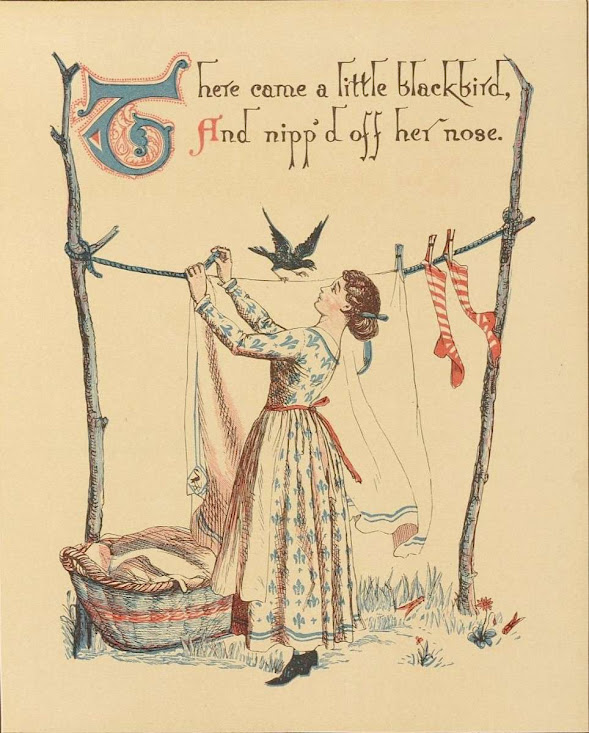 |
There came a little blackbird,
And nipp'd off her nose. |
1865 A Gaping Wide Mouth Wadding Frog:
 |
| Front Cover |
 |
| End-paper |
 |
| A gaping-wide-mouth-waddling frog, |
 |
| Three monkeys tied to a log, |
 |
| Four puppies with our dog Ball, |
 |
| Five beetles against the wall, |
 |
| Six Joiners in Joiners’ Hall, |
 |
| Seven lobsters in a dish, |
 |
| Eight peacocks in the air, |
 |
| Nine ships sailing on the main, |
 |
| End-paper |
1869 1. 2. Buckle My Shoe published by George Routledge & Sons:
 |
| Front Cover |
 |
1, 2. One Two, Buckle my shoe.
3, 4. Three, Four, Open the door. |
 |
5, 6. Five, Six, Pick up sticks
7, 8. Seven Eight, Lay them straight. |
 |
9. 10. Nine, Ten
A good fat Hen. |
 |
11, 12. Eleven, Tweleve.
Ring the Bell. |
 |
13, 14. Thirteen, Fourteen,
Maids ate courting. |
 |
15, 16. Fiteen, Sixteen,
Maids in the Kitchen. |
 |
17. 18. Seventeen, Eighteen,
Maids in waiting. |
 |
19, 20. Nineteen, Twenty.
My plate is empty. |
1870 The Fairy Ship
published by George Routledge & Sons:
 |
| Front Cover |
 |
| End Paper |
 |
| Title Page |
 |
The Captain was a Duck,
With a jacket on his back. |
 |
There were fifty little sailors
Skipping o'er the decks;
There were fifty little white mice,
With rings around their necks! |
 |
| Almonds in the hold; |
 |
A Ship, a Ship, a sailing,
Sailing o'er the sea;
And it was deeply laden
With good things for me! |
 |
For me, for me, foe me!
And it was deeply laden
With good things for me! |
 |
The sails they were of satin,
The mast it was of gold,
Of gold, of gold, of gold! |
 |
And when the Ship set sail.
The Captain he said Quak!
Quack, quack quack!
And when the Ship set sail,
The Captain he said Quak! |


