Monday, 1 September 2025

British Seaside Posters - part 1

In 1871, the British Government declared the Bank Holidays act, throughout the year there were official holidays allowing people time away from their jobs. While the wealthier families often stayed for a week in the summer, the great improvements made to the railway system some thirty years before allowed the working classes to get away on day trips for some healthy fresh air at seaside towns. This great influx of visitors led entrepreneurs to build accommodation and new attractions to capitalise and kick started economic growth in the coastal towns.

This is part 1 of a 4-part series on British Seaside Posters:

c1908 G.N.R. (Great Northern Railway)
Skegness is So Bracing by John Hassall

c1908 G.N.R. Skegness by John Hassall

1908 Skegness is So Bracing by John Hassall: The Jolly Fisherman is a poster created by artist John Hassall in 1908 after he had been commissioned by the Great Northern Railway (GNR). It is regarded as one of the most famous holiday advertisements of all time and is believed to have influenced the success of Skegness, Lincolnshire as a holiday destination. Hassall was paid 12 Guineas for his work, and the original painting hangs in the town hall at Skegness. The poster depicts a fisherman skipping along the beach, with the slogan "Skegness is SO bracing". There are different versions of the poster, however, the fisherman and the slogan are always part of the design; one such later design, promoted by the LNER, showed the same fishermen design being tugged along the beach by a toddler hanging onto his scarf. John Hassall visited Skegness in 1936, and was quoted as saying "[that Skegness] was even more bracing and attractive than I had been led to expect.”

Note: A series on the works of John Hassall can be found in the index.

1908 Skegness is So Bracing
John Hassall

1908 Skegness is So Bracing
John Hassall

1908 Skegness is So Bracing
It's Quicker By Rail
John Hassall

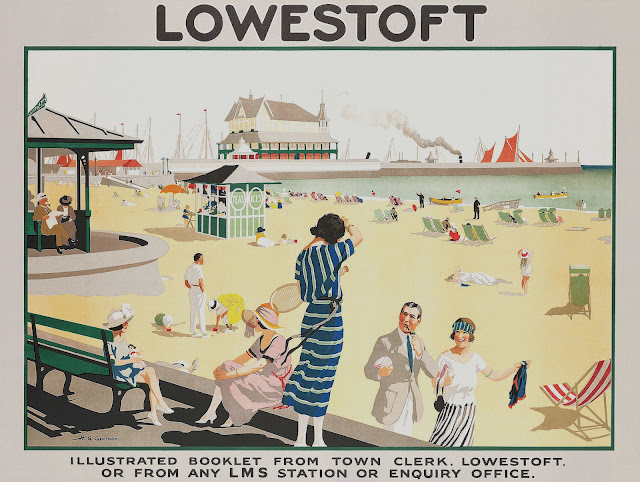
1920s Lowestoft by Henry George Gawthorn (1879-1941) was born in Northampton and studied at the Regent Street Polytechnic and old Heatherley School. He began his career in an architect’s office before turning to painting. His work both fine and commercial art; he exhibited at the Royal Academy and with the Society of Graphic Art.

1920s Lowestoft LMS
Henry George Gawthorn

1921 Brighton (UK)
 French poster

c1923 Saltburn by the Sea L.N.E.R.
Henry George Gawthorn
Frank Newbould was a poster and black-and-white artist, born in 1887 in Bradford, UK. He studied at the local College of Art and won several silver and bronze medals in national competitions. During and after World War I he was a black-and-white artist, working for such publications as Passing Show, but more profitable poster work attracted him, and he became one of the most prolific and distinguished practitioners in the inter-war period. Initially he worked for Morton Studios in Fleet Street, then set up his own studio. His posters for Orient Lines and London North Eastern Railway were notable, especially landscapes studied on location. Exhibited Chenil Galleries and lived in London. He died in 1951.

c1923 Dunbar
Frank Newbould

1924 Southend-On-Sea
LM&S - L&N,E & Underground Railways
Verney L. Danvers

c1925 Saltburn by the Sea L.N.E.R.
Henry George Gawthorn

c1925 Great Yarmouth & Gorleston on Sea for Happy Healthy Holidays
Septimus E. Scott

c1925 Cruden Bay by East Coast Route L.N.E.R.
Tom Purvis

1925 Southend-On-Sea District or Central London Railways
Frank Newbould

1925 Eastbourne, Southern Railway
Kenneth Denton Shoesmith

1925 East Coast by L.N.E.R.
Tom Purvis

1926 Hornsea East Yoks L.N.E.R.
Harry Hudson Rodmell

1926 Clacton-on-Sea, L.N.E.R.
Henry George Gawthorne

c1927 Southend-On-Sea L.M.E.R.
R.T. Roussel

1927 St. Andrews L.N.E.R.
Henry George Gawthorn

1928 Knaresborough
 It's Quicker By Rail L.N.E.R.
Henry George Gawthorn

c1929 Yorkshire Coast - by LNER
Tom Purvis

c1929 Travel via LMS
Septimus E. Scott

1929 Eastbourne Southern Railway
Kenneth D. Shoesmith

1929 Broadstairs, Southern Railway
John Edmund Mace

c1930 Redcar, L.N.E.R.
Henry George Gawthorn

c1930 New Brighton & Wallasey, LMS
Septimus E. Scott

c1930 Morecambe & Heysham, LMS
Septimus E. Scott


c1930 Lancashire Coast, LMS
Septimus E. Scott

c1930 Hunstanton, L.N.E.R.
Wilton Williams

c1930 Fraserburgh, L.N.E.R.
Henry George Gawthorn

c1930 Dovercourt Bay Holiday Lido
It's Quicker By Rail, L.N.E.R.
Septimus E. Scott

c1930 Blackpool
Fortunino Matanis R.I.

1930 The Belgian Coast, L.N.E. R.
Frank Newbould

1930 Scarborough, L.N.E.R.
Frank Newbould

1930 Brighton
Come down and see me sometime!
artist unknown

1930 Bangor Northern Ireland
British Railways
Frank Sherwin

Friday, 29 August 2025

René Magritte - part 2

René François Ghislain Magritte was born on November 21, 1898, in Lessines, Belgium. He studied intermittently between 1916 and 1918 at the Académie Royale des Beaux-Arts in Brussels. Magritte first exhibited at the Centre d’Art in Brussels in 1920. After completing military service in 1921, he worked briefly as a designer in a wallpaper factory. In 1923 he participated with Lyonel Feininger, El Lissitzky, László Moholy-Nagy, and Belgian Paul Joostens in an exhibition at the Cercle Royal Artistique in Antwerp. In 1924 he collaborated with E. L. T. Mesens on the review Oesophage.

In 1927 Magritte was given his first solo exhibition at the Galerie Le Centaure in Brussels. Later that year the artist left Brussels to establish himself in Le Perreux-sur-Marne, near Paris, where he frequented the Surrealist circle, which included Jean Arp, André Breton, Salvador Dalí, Paul Eluard, and Joan Miró. In 1928 Magritte took part in the Exposition surréaliste at the Galerie Goemans in Paris. He returned to Belgium in 1930, and three years later was given a solo show at the Palais des Beaux-Arts in Brussels. Magritte’s first solo exhibition in the United States took place at the Julien Levy Gallery in New York in 1936 and the first in England at the London Gallery in 1938. He was also represented in the 1936 Fantastic Art, Dada, Surrealism exhibition at the Museum of Modern Art in New York.

Throughout the 1940s Magritte showed frequently at the Galerie Dietrich in Brussels. During the following two decades he executed various mural commissions in Belgium. From 1953 he exhibited frequently at the galleries of Alexander Iolas in New York, Paris, and Geneva. Magritte retrospectives were held in 1954 at the Palais des Beaux-Arts in Brussels and in 1960 at the Museum for Contemporary Arts, Dallas, and the Museum of Fine Arts in Houston. On the occasion of his retrospective at the Museum of Modern Art in New York in 1965, Magritte traveled to the United States for the first time, and the following year he visited Israel. Magritte died on August 15, 1967, in Brussels, shortly after the opening of a major exhibition of his work at the Museum Bojmans Van Beuningen in Rotterdam.


All images © ADAGP, Paris and DACS, London 2025

Part 2 of a 2-part post on the works of Réne Magritte: 

1939 Poison
gouache on paper 33.5 x 40.7 cm
Museum Boijmans Van Beuningen, Rotterdam, Netherlands

1940-44 A Rose and a Tower
graphite on thin, buff drawing paper 15.2 x 10.1 cm
LACMA (Los Angeles County Museum of Art, CA)

c1940-44 Phallic Roses
graphite on thin, buff drawing paper 15.2 x 10.1 cm
LACMA (Los Angeles County Museum of Art, CA)

c1940-44 Head with Flower
graphite on thin, buff drawing paper 15.2 x 10.1 cm
LACMA (Los Angeles County Museum of Art, CA)

c1940-44 Flower with Head
graphite on thin, buff drawing paper 15.2 x 10.1 cm
LACMA (Los Angeles County Museum of Art, CA)

1942 Treasure Island
gouache on paper 42.5 x 60.5 cm
Museo Tamayo Arte Contemporáneo: Fundación Proa, Buenos Aires

1943-53 Homesickness
watercolour and gouache, over touches of graphite, on cream wove paper 45.5 x 35.1 cm
Art Institute of Chicago, IL

c1943 Untitled (Woman-Bottle)
oil on glass bottle 37.7 x 7.6 cm
Art Institute of Chicago, IL

1944-54 The Balcony
red chalk with stumping on cream wove paper 44.5 x 36.5 cm
Art Institute of Chicago, IL
Gift of Mr. and Mrs. Joseph R. Shapiro

1947 The Liberator
oil on canvas 99.5 x 79.05 cm
LACMA (Los Angeles County Museum of Art, CA)

1947-48 Seasickness
oil on canvas 54 x 65 cm
Art Institute of Chicago, IL

1950 The Labours of Alexander
oil on canvas (size not found)
Private Collection

1967 The Labours of Alexander
sculpture cast bronze in two pieces: tree trunk 63.5 x 152.4 x 104.1 cm Axe 134.6 cm long
Sydney and Walda Besthoff Sculpture Garden, New Orleans

1950 The Wasted Footsteps
oil on canvas 55.9 x 46.5 cm
Collection of the Akron Art Museum, Ohio

1950 The Legend of the Centuries
oil on canvas 80.5 x 60.6 cm
National Galleries of Scotland, Edinburgh

1953-54 Empire of Light: 

Numerous versions of which exist (Museum of Modern Art, New York, the Menil Collection, Houston, and the Musées Royaux des Beaux-Arts de Belgique, Brussels).

1950 The Empire of Light
oil on canvas 78.8 x 99.1 cm
MoMA, New York

1952 The Listening Room
oil on canvas 55 x 45 cm
Menil Collection, Houston, TX

1953 Golconda
oil on canvas 100 x 81 cm
Menil Collection, Houston, TX

1953 The Wonders of Nature
oil on canvas 108.3 x 128.6 cm
Museum of Contemporary Art Chicago, IL


1953-54 Empire of Light
oil on canvas 195.4 x 131.2 cm
Peggy Guggenheim Collection, Venice
(Solomon R. Guggenheim Foundation, New York)

1954 The Empire of Light
oil on canvas
Royal Museums of Fine Arts of Belgium, Brussels

1955 Memory of a Voyage
oil on canvas 162.2 x 130.2 cm
MoMA, New York

1958 The Banquet:

This canvas is the last, largest, and most impressive of four oil paintings of this title; the three other paintings are all dated to 1957. There are also five versions of this image in gouache, starting in 1956 and extending to 1964, Magritte first realised the idea and conceived the title for this series in the first of these gouaches completed in 1956 shortly after he announced to Mirabelle Dors and Maurice Rapin, in a letter of November 9, 1956, that “Le Banquet” was one of his latest “finds”


1958 The Banquet
oil on canvas 97.3 x 130.3 cm
Art Institute of Chicago, Il
 Lindy and Edwin Bergman Collection

c1958 Though all the winds of doctrine were let loose to play…
gouache on paper mounted on paperboard
Smithsonian American Art Museum, Washington, DC

1961 Empire of Light
oil on canvas 114.5 x 146 cm

c1962 “Those who cannot remember the past are condemned to repeat it"
(version of 'The legend of the centuries 1950)
gouache and pencil on paper mounted on paperboard
Smithsonian American Art Museum, Washington, DC

1962 Ceci n'est pas une pipe
(version of the 1928 painting)
etching on paper 24.1 x 20.1 cm

1963 Perspective
crayon on pape 35.9 x 26.9 cm
MoMA, New York

1963 The Indiscreet Jewels
lithograph 23.4 x 30.5 cm
MoMA, New York

1963 The Natural Graces
oil on canvas 55 x 40 cm
Private Collection

1967 The Natural Graces
bronze with golden brown patina 102.6 x 42.8 cm

1964 The Tune and Also the Words
gouache over traces of graphite on cream wove paper
36.2 x 54.8 cm
Art Institute of Chicago, IL
Lindy and Edwin Bergman Collection

1964 The Son of Man
oil on canvas 116 x 89 cm
Private Collection

1964 The Great War
oil on canvas. 60 x 81 cm

1965 The Thought Which Sees
pencil on paper 40 x 29.7 cm
MoMA, New York

1965 The Idol
(Homage to Alexandre Iolas)
lithograph 58.4 x 66 cm
Fine Arts Museums of San Francisco, CA

1965 The Blank Signature
(Attributed to Magritte)
oil on canvas 81.3 x 65.1 cm
National Gallery of Art, Washington, DC

1965 The Blank Signature
(Attributed to Magritte)
graphite with charcoal, brown ink, and oil paint (?) on wove paper 35.8 x 26.9 cm
National Gallery of Art, Washington, DC

1966 Landscape of Baucis
aquatint and lift-ground aquatint in black on wove paper
22.5 x 16.9 cm (plate)
National Gallery of Art, Washington, DC

1966 Decalcomania
oil on canvas 81 x 100 cm
Centre Pompidou, Paris

1966 Collage
collage, pencil & ink

1967 The blank page
oil on canvas 54 x 65 cm
Royal Museums of Fine Arts of Belgium, Brussels, Belgium

1967 The beautiful relations
oil on canvas 41 x 33 cm
Private collection


1967 The Age of Enlightenment
oil on canvas (size not found)

1967 As you will like it
etching in black on buff wove paper, laid down on white wove paper 19.7 x 15 cm (plate)
Art Institute of Chicago, IL

1968 (printed) published 1969 Rose and pear
colour etching and aquatint 15.6 x 10.6 cm (plate)