Tuesday, 24 June 2014

Rembrandt – part 2


Rembrandt 1628-30c Self-Portrait 
oil on panel 38.2 x 31 cm 
Germanisches Nationalmuseum, Nuremberg

Rembrandt Harmenszoon van Rijn (1606 – 1669) is considered one of the greatest painters and printmakers in European art and the most important in Dutch history. Having achieved youthful success as a portrait painter, Rembrandt’s later years were marked by personal tragedy and financial hardships. Yet his etchings were popular throughout his lifetime, his reputation as an artist remained high, and for twenty years he taught many important Dutch painters. His greatest creative triumphs are exemplified especially in his portraits of his contemporaries, self-portraits and illustrations of scenes from the Bible. His self-portraits form a unique and intimate biography, in which the artist surveyed himself without vanity and with the utmost sincerity.

This is part 2 of a 14 - part post on the works of Rembrandt. For full biographical notes see part 1, the introduction.


Rembrandt 1624-25 The Operation ( Touch ) 
oil on panel 21.5 x 17.7 cm 
Private Collection

1624-25 The Operation
Rembrandt painted the picture at the age of about 17 years in his native city Leiden, the cradle of Dutch paintings in the 17th century.

The painting was originally part of a series of five small paintings with the theme of the Five Senses.  Two of the three remaining preserved paintings “The Operation” (Touch) and “The Three Singers” (Hearing) are located in a private collection in New York. The third piece “The Spectacle-Pedlar” (Sight) is now maintained as a Dutch cultural heritage piece.

Rembrandt 1624-25c The Three Singers ( Hearing ) 
oil on oak panel 21.6 x 17.8 cm 
Private Collection

Rembrandt 1624-25 The Spectacle-Pedlar ( Sight ) 
oil on panel 21.5 x 19.5 cm 
Museum De Lakenhal, Leiden, Netherlands

Rembrandt 1624-28 Circumcision 
etching on paper 21.3 x 16.7 cm

Rembrandt 1624-28 Rest on the Flight into Egypt 
etching on paper 21.2 x 16.4 cm

Rembrandt 1625 The Stoning of Saint Stephen 
oil on panel 89.5 x 123.6 cm 
Musée des Beaux-Arts de Lyon, France

Rembrandt 1625-26c Oriental Ruler on Horseback 
pen and bistre 16 x 12.6 cm

Rembrandt 1625-26c The Triumph of Mordecai 
pen and brush in bistre, and wash 21 x 26.4 cm 
 Kunsthalle, Bremen, Germany

Rembrandt 1625-31 Bust of a Man with a Cap 
etching on paper 4.9 x 3.8 cm ( plate )

Rembrandt 1625-31 Self-Portrait with Fur Hat 
etching and engraving on paper 6 x 5.6 cm

Rembrandt 1625-35 Grotesque Profile of Man with High Hat 
etching on paper 3.8 x 2.6 cm ( plate )

Rembrandt 1625-35 Man in Hat with Earflaps 
etching on paper 5 x 3.8 cm ( plate )

Rembrandt 1625-35 Self-Portrait with Hat and Dark Cloak 
etching on paper 6.6 x 6 cm ( plate )

Rembrandt 1625-36c A Woman and Child Descending a Staircase 
ink and wash sketch 18.7 x 13.2 cm 
Pierpoint Morgan Library, New York

Rembrandt 1625-50 Portrait of the Actor William Bartholsz Ruyter 
pen in brown, white body colour on light brown prepared paper 13.9 x 17.4 cm

Rembrandt 1625c Bust of an Old Man with Turban 
oil on panel 26.5 x 20 cm 
Pinacothèque de Paris

Rembrandt 1626 Balaam and his Ass 
oil on oak panel 63.2 x 46.5 cm 
Musée Cognacq-Jay, Paris

Rembrandt 1626 Christ Driving the Money Changers from the Temple 
oil on oak panel 43.1 x 32 cm 
Pushkin Museum, Moscow

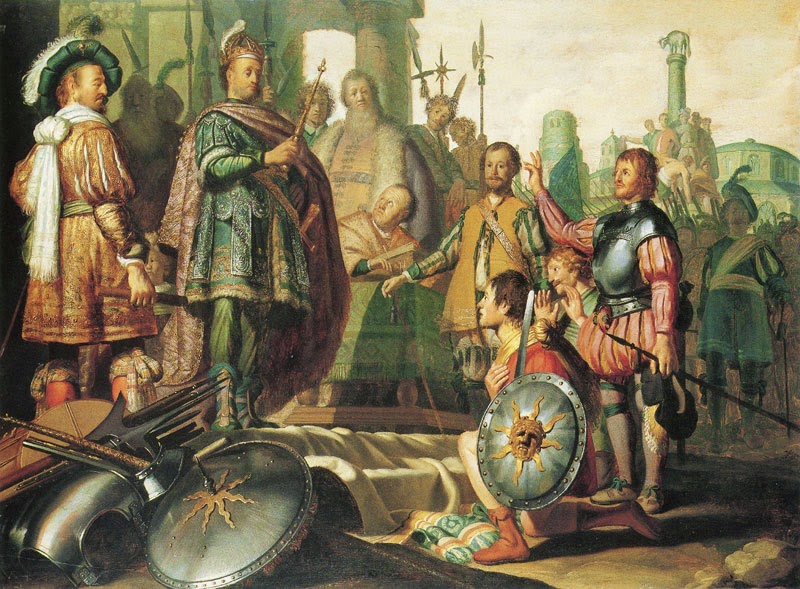
Rembrandt 1626 History Painting 
oil on panel 90.1 x 121.3 cm 
Stedelijk Museum De Lakenhal, Leiden

Rembrandt 1626 Musical Company 
oil on panel 63.5 x 48 cm 
Rijksmueum, Amsterdam

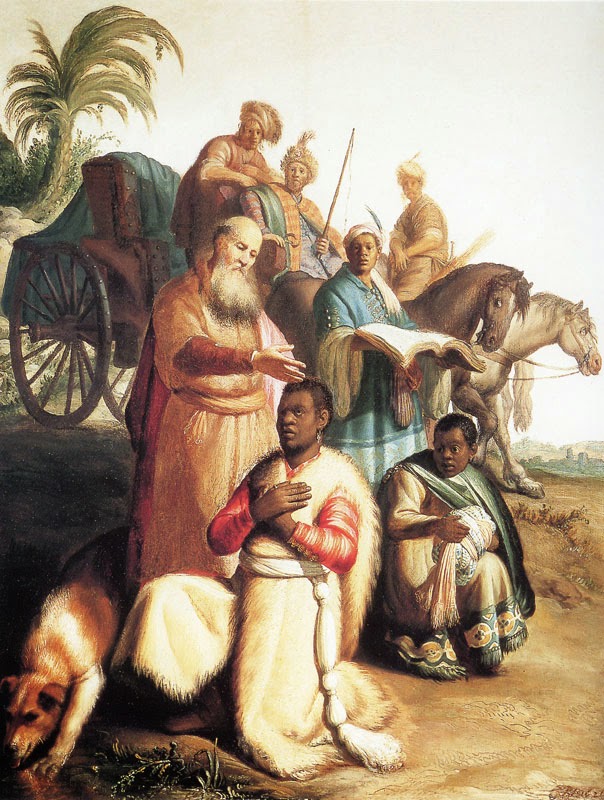
Rembrandt 1626 The Baptism of the Eunuch 
oil on panel 63.5 x 48 cm 
Catharijne Convent, Utrecht

Rembrandt 1626 Tobit and Anna with the Kid 
oil on panel 39.5 x 30 cm 
Rijksmueum, Amsterdam

Rembrandt 1626 Two Studies of the Head of an Old Man 
pen and brown ink on paper 9 x 14.9 cm 
J. Paul Getty Museum, Los Angeles, CA

Rembrandt 1626-27 Bust of a Man in a Gorget and a Feathered Beret 
oil on oak panel 40 x 29.4 cm

Rembrandt 1626-30 Beggar 
etching on paper 12.2 x 9.5 cm

Rembrandt 1626-30 Self-Portrait Leaning Forward 
etching on paper 6.4 x 5 cm ( plate )

Rembrandt 1626-30 Self-Portrait with Wide Nose 
etching on paper 7.1 x 5.9 cm

Rembrandt 1626-30 Self-Portrait, Listening, Leaning Forward 
etching on paper 6.5 x 5.2 cm

Rembrandt 1626-32 Bearded Old Man with High Forehead 
etching on paper 8.7 x 7.3 cm

Rembrandt 1626-35 Man with Beard and Hat 
etching on paper 5 c 4.1 cm ( plate )

Rembrandt 1627 David, Presenting the Head of Goliath to King Saul 
oil on panel 27.5 x 39.5 cm 
Kunstmuseum, Basel

Rembrandt 1627 Parable of the Rich Man 
oil on oak 31.9 x 42.5 cm 
Staatliche Museen, Berlin

Rembrandt 1627 St. Paul in Prison 
oil on panel 72.8 x 60.2 cm 
Staatsgalerie, Stuttgart

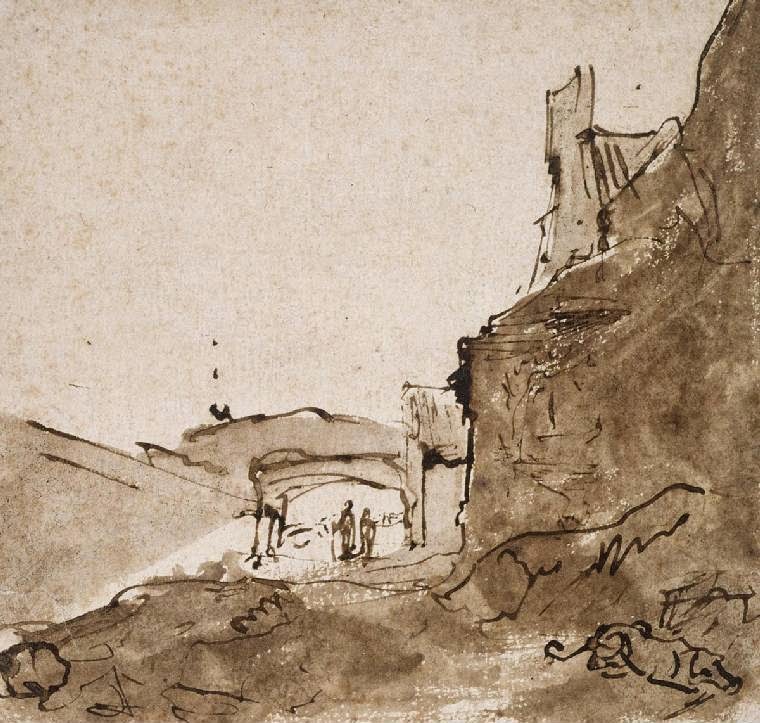
Rembrandt 1627-28 Outskirts of a Town with Walls and a Doorway 
pen and indian ink and brown wash on paper 15.2 x 14.3 cm 
Fitzwilliam Museum, Cambridge, UK

Rembrandt 1627-28 Simeon in the Temple 
oil on panel 55.4 x 43.7 cm 
Kunsthalle, Hamburg

Rembrandt 1627-29c Soldier on Horseback Blowing a Trumpet 
pen and bistre and grey washes 28 x 22.8 cm 
Rijksprentenkabinet, Amsterdam

Rembrandt 1627-31 Beggar with Deformed Hand, Leaning on a Stick 
etching 9 x 4.2 cm

Rembrandt 1627-31 Kneeling Hieronymous 
etching on paper 38.9 x 33.2 cm

Rembrandt 1627-31 Peter and John Healed a Lame Man at the Temple Gate 
etching on paper 22.1 x 16.9 cm

Rembrandt 1627-31 Self-Portrait with Fur Hat 
etching on paper 6.2 x 5 cm

Rembrandt 1627-31 The Blind Tobias 
etching on paper 7.8 x 5.5 cm

Rembrandt 1627-31 The Small Lion Hunt 
etching on paper 15.8 x 11.8 cm

Rembrandt 1627-32 Head of a Man with Fur Hat, Shouting 
etching on paper 3.5 x 2.8 cm

Rembrandt 1627-35 Head of an Old Woman 
etching on paper 3.5 x 4.3 cm

Rembrandt 1627c Man Pulling a Rope 
red chalk 27.3 x 17.6 cm 
Graphische Sammlung, Munich, Germany

Rembrandt 1627c Self-Portrait 
oil on wood 24 x 17 cm 
Staatliche Museen, Kassel

Rembrandt 1628 Self-Portrait 
oil on panel 22.6 x 18.7 cm 
Rijksmuseum, Amsterdam

Rembrandt 1627c Study of an Archer 
red chalk heightened with white 27.7 x 17.7 cm  
Graphische Sammlung, Munich, Germany

Rembrandt 1627c Study of an Archer 
red chalk heightened with white 30.6 x 16.2 cm 
Kupferstichkabinet, Dresden, Germany

Rembrandt 1628 Blind Man Leaning on a Stick 
pen and bistre 13 x 11.5 cm

 Rembrandt 1628 Rembrandt's Mother 
etching on paper 6.3 x 6.4 cm

Rembrandt 1628 Rembrandt's Mother 
etching retouched with black chalk on paper 6.5 x 5.8 cm

Rembrandt 1628 Rembrandt's Mother 
etching on paper 6.5 x 6.3 cm

Rembrandt 1628 Samson and Delilah 
oil on panel 59.5 x 49.5 cm
 Gemäldegalerie, Berlin

Rembrandt 1628 The Artist in His Studio 
oil on panel 25.1 x 31.9 cm 
Museum of Fine Arts, Boston, MA

Rembrandt 1628 Two Old Men Disputing ( Peter and Paul? ) 
oil on oak panel 72.4 x 59.7 cm 
National Gallery of Victoria, Melbourne, Australia

Rembrandt 1628-29 Self-Portrait 
sketch on paper 12.7 x 9.4 cm 
Rijksmuseum, Amsterdam

Rembrandt 1628-29c A Scholar by Candlelight 
oil on copper 13.9 x 13.9 cm 
Collection of Isabel and Alfred Bader, Milwaukee

Rembrandt 1628-29c Beggar Couple with a Dog 
pen and bistre 16.5 x 14.5 cm

Rembrandt 1628-29c Beggar Woman Leaning on a Stick 
pen and brush 13.5 x 12 cm

Rembrandt 1628-29c Man in a Flat Cap 
pen and bistre 14.4 x 10.8 cm 
Kupferstichkabinett, Dresden, Germany

Rembrandt 1628-29c Oriental 
pen and brush in olive brown bistre 17.3 x 10.8 cm 
École des Beaux-Arts, Paris

Rembrandt 1628-29c Rembrandt's Mother 
pen and brush 12 x 10.5 cm

Rembrandt 1628-29c Standing Beggar Turned to the Right 
29.2 x 17 cm 
Rijksprentenkabinet, Amsterdam

Rembrandt 1628-29c Young Worker Leaning on a Spade 
pen and bistre 14.4 x 8.6 cm

Rembrandt 1628-30 Head of an Old Man ( in a Cap ) 
oil on oak panel 24.3 x 20.3 cm 
Agnes Etherington Art Centre, Kingston, Ontario, Canada

Rembrandt 1628-31 Bust of a Bald Man with a Fur Coat 
etching on paper 6.6 x 5.8 cm

Rembrandt 1628-31 Self-Portrait with Shaggy Hair 
etching on paper 6 x 5.6 cm

Rembrandt 1628-32 Beggar in a High Cap, Standing and Leaning on a Stick 
etching on ivory laid paper 15.3 x 10.8 cm ( sheet ) 
Art Institute of Chicago, IL

Rembrandt 1628-32 Beggar Warming Hands at a Brazier 
etching on paper 7.7 x 4.6 cm

Sunday, 22 June 2014

Rembrandt – part 1 Introduction

Portrait of Rembrandt van Rijn by Jan Lievens c1629 
oil on panel 57 x 44.7 cm 
Rijksmuseum, Amsterdam


Rembrandt Harmenszoon van Rijn (1606 – 1669) was born in 1606 in Leiden, Holland, the ninth child of a well-to-do family, son of a Miller and a Baker’s daughter. He attended elementary school from 1612 to 1616 and then attended the Latin School in Leiden, where he partook in biblical studies and lessons on the classics. It is unclear whether Rembrandt completed his studies at the Latin School, but one account claims that he was removed from school early and sent to be trained as a painter at his own request. From 1620 to either 1645 or 1625, Rembrandt trained as an artist under two masters. His first was the painter Jacob van Swanenburgh (1571 – 1638), with whom he studied for about three years. Under van Swanenburgh, Rembrandt would have learned basic artistic skills. Van Swanenburgh specialised in scenes of hell and the underworld, and his ability to paint fire and the way its light reflects on surrounding objects was likely an influence on Rembrandt’s later work.


Jacob van Swanenburgh "Aeneas and Sibilla in the Underworld" c1625 
National Museum, Gdansk

Rembrandt’s second teacher was Amsterdam’s Pieter Lastman (1583 – 1633), who was a well-known history painter and likely helped Rembrandt to master the genre, which included placing figures from biblical, historical and allegorical scenes in complex settings.


Pieter Lastman "Juno discovering Jupiter with Io" 1618 
oil on wood 
The National Gallery, London

In 1625 Rembrandt settled back in Leiden, now a master in his own right, and over the next six years he laid the foundations for his life’s work. It was during this time that Lastman’s influence was most noticeable, as in several instances Rembrandt deconstructed his former master’s compostions and reassembled them into his own, a practice carried on by Rembrandt’s own pupils later on. Rembrandt’s paintings created at this time were general small but rich in detail - religious and allegorical themes were prominent. He also worked on his first etchings in Leiden, and his eventual international fame would rely on the widespread dissemination of these works. Diverging from his contemporaries, Rembrandt endowed his etchings with a painterly quality achieved through suggestive handling of light and dark.


1652-56 The Presentation in the Temple 
etching and drypoint on paper 20.9 x 16 cm

Rembrandt’s style soon took an innovative turn involving his use of light. His new style left large areas of his paintings obscured in shadow; through his interpretation, illumination grew rapidly weaker as it extended into the painting, creating spots of brightness and pockets of deep darkness. In this vein, in 1629 Rembrandt completed “Judas Repentant, Returning the Pieces of Silver,” among others – works that further evidence his handling of light.

1629 Judas Repentant, Returning the Thirty Pieces of Silver 
oil on panel 79 x 102.3 cm 
Private Collection

Another example is the 1628 work “Two Old Men Disputing” (Peter and Paul?), in which the painting’s lighted elements are clustered together and surrounded by darker tones, drawing the viewer’s eye to a general focal point before moving in to observe the details within.


1628 Two Old Men Disputing ( Peter and Paul? ) 
oil on oak panel 72.4 x 59.7 cm
National Gallery of Victoria, Melbourne, Australia

Starting in 1628, Rembrandt took on students, and over the years his fame attracted many young artists seeking to learn at his side. Only an estimate of the number of his pupils can be made, since official registers of trainees have been lost, but it is believed that over the course of his career he had fifty or so students. In around 1631 Rembrandt moved to Amsterdam from Leiden and began to do business with Hendrick van Uylenburgh, an Amsterdam entrepreneur who had a workshop that created portraits and restored paintings, among other activities. Lodging in van Uylenburgh’s hous he met his landlord’s young cousin Saskia. They married in 1634. Numerous paintings of her suggest they were happily married. In 1636 Saskia gave birth to their first son Rumbartus, who died after only two weeks. Over the next four years two more children were born, but also within a couple of months.


1635 Saskia van Uylenburgh in Arcadian Costume as Flora 
oil on canvas 123.5 x 97.5 cm 
National Gallery, London

Rembrandt began to paint dramatic, large-scale biblical and mythological scenes using his high-contrast method of light and dark, such as “The Blinding of Samson” (1636) and “Danaë” (1636).


1636 The Blinding of Samson 
oil on canvas 276 x 206 cm 
The Städel, Frankfurt am Main, Germany

1636-43 Danaë 
oil on canvas 185 x 202.5 cm 
Hermitage Museum, St. Petersburg, Russia

In Amsterdam, Rembrandt also painted numerous commissioned portraits with the help of various assistants in Uylenburgh’s shop. He produced more energetic works than those created by the portrait artists so prevalent in Amsterdam at the time, and he received numerous commissions despite his questionable ability to capture the likeness of his subject. To this point, Constantijn Huygens, a Dutch diplomat, mocked a portrait Rembrandt had done of one of his friends for its lack of verisimilitude, and Rembrandt’s self-portraits contained noticeable physiognomic differences from one image to the next. In 1641 a fourth child, Titus, was born – and lived. Saskia was unwell after the birth and Rembrandt made various drawings of her looking tired and drawn in bed. In 1642 Saskia made a will leaving Rembrandt and Titus her fortune, although most of Rembrandt’s share would be lost if he remarried. She died shortly after, still aged only 30, probably from plague or TB.


1640-42 Interior with Saskia in Bed 
pen and brown ink with brown and grey wash and some additions in red and black chalk 
The Frick Collection, New York

In the ten years following the unveiling of “The Night Watch (1642),” Rembrandt’s overall artistic output diminished drastically. Speculation about what happened after “The Night watch” has contributed to the “Rembrandt myth,” according to which the artist became largely misunderstood and was ignored. Often blamed for Rembrandt’s supposed downfall are the death of his wife and the supposed rejection of “The Night Watch” by those who commissioned it. But modern research has found no evidence that the painting was rejected or that Rembrandt experienced deep devastation on his wife’s death. There is also no evidence that he was ever “ignored,” although he was often the target of his contemporary critics’ barbs.


1642 The Company of Frans Banning Cocq and Willem van Ruytenburch, known as the ‘Night Watch’
oil on canvas 379.5 x 453.5 cm 
Rijksmuseum, Amsterdam

It has been put forth that Rembrandt’s crisis may have been an artistic one that had seen his methods stretched to their practical limits, and the variations in his few paintings from 1642 to 1652 – the period that marks the beginning of what is usually referred to as Rembrandt’s “late style” – might be seen as a sign that he was searching for a new way forward. In the 1650s Amsterdam was hit by a massive economic depression. Rembrandt had not even completed half the payments on his house and his creditors began to chase him for money. In July 1656, he successfully applied for ‘cession bonorum’ – a respectable form of bankruptcy which avoided imprisonment. All his goods, including an impressive collection of paintings, were sold off for a pittance and he moved across town to a much poorer district. He had always used himself as a model, but in the last twenty years of his life he painted self-portraits with increasing frequency. He died in 1669.


[Biography adapted from Rembrandt Harmenszoon van Rijn. (2014). The Biography.com website and from The National Gallery, London]


Rembrandt's house in Amsterdam 
photo: Creative Commons Licence

This introduction is part 1 of a 14 – part post on the works of Rembrandt. Other sites featuring Rembrandt's work mainly divide his works by category - oils, prints, and drawings. I'll be showing all his works together in chronological order (including the works shown here) to give a better sense of his working practice.