Monday, 23 November 2015

W. Heath Robinson – part 6

William Heath Robinson (1872 – 1944) was an English illustrator and cartoonist, best known for his drawings of complicated machines for achieving simple objectives. “Heath Robinson Contraption” is a phrase that entered the language during WW1 in Britain, and later in the United States.


William wrote and illustrated three highly successful children’s books (The Adventures of Uncle Lubin 1902, Bill the Minder 1912, Peter Quip in Search of a Friend 1933) as well as illustrating numerous others.

In the run up to WW1, Robinson became known for a series of drawings in magazines such as The Sketch and The Tatler, many of which I will be featuring in this comprehensive look at his work.


This is part 6 of a 20 – part series on the works of W. Heath Robinson


1909 A Song of the English:

Front Cover

Title Page

Frontispiece


Original Artwork
watercolour 51.1 x 25.4 cm 
The Metropolitan Museum of Art, New York


*            *            *

1909 for "The Sketch"
In the Scrambling Trenches of an Egg Arsenal
pen and ink and watercolour Pen and ink 12.7 x 24.1 cm


1910 Collected Verse of Rudyard Kipling:


Front Cover

Frontispiece "We've sent out little Cupids all ashore"

Title Page

The Fires

Dedication from "Barrack Room Ballads"


I remember going crazy

Loud sang the sound of the jolly, jolly mariners

As out on the bridge she rolls

"Sister of mine, pass, free from shame. Pass with thy King to rest!"

The Three Decker

"Ung" 
pen and ink 31.1 x 12.7 cm

Tomlinson

An' the man that spied me first was our good old grinnin', grintin' Gunga Din

The explanation

She laid it into her breast

Barrack Room Ballads - Indian Service "Mandalay"

Mary, pity woman

Me that 'ave followed my trade in the place where the Lightnin's are made

Friday, 20 November 2015

W. Heath Robinson – part 5


William Heath Robinson (1872 – 1944) was an English illustrator and cartoonist, best known for his drawings of complicated machines for achieving simple objectives. “Heath Robinson Contraption” is a phrase that entered the language during WW1 in Britain, and later in the United States.


William wrote and illustrated three highly successful children’s books (The Adventures of Uncle Lubin 1902, Bill the Minder 1912, Peter Quip in Search of a Friend 1933) as well as illustrating numerous others.

In the run up to WW1, Robinson became known for a series of drawings in magazines such as The Sketch and The Tatler, many of which I will be featuring in this comprehensive look at his work.


This is part 5 of a 20 – part series on the works of W. Heath Robinson


1905 Stories from Chaucer Told to the Children:


Frontispiece

"He Saw The Magician Standing On the Shore"

"Lord Walter Came Into the Room"

"Palamon Lay Beside a Pool of Water"

"She Rose to Curtsy To Him"

"She thought of the two young princes who were prisoners there"

"To Them She Seemed a Martyr"

"When Her Boy Lay Asleep She Knelt At the Prow"


1905 Twelfth-Night or What You Will:


Front Cover

Title Page

Clown. Sayest thou that house is dark?

Clown. No sir, I live by the church

Malvolio. They have here propertied me; keep me in darkness

O time! Thou must untangle this, not I

O, when mine eyes did see Olivia first

Olivia. Well, come again to-morrow; fare thee well

Practising behaviour to his own shadow

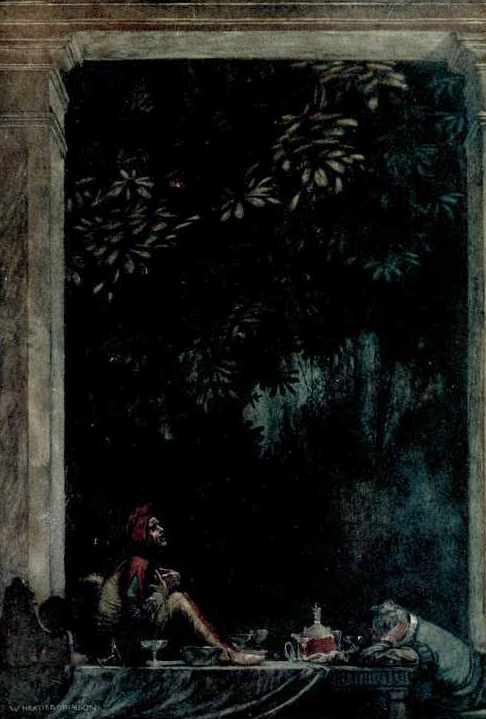
Present mirth hath present laughter

So full of shapes is fancy

That can sing both high and low

Viola. She pined in thought

What country, friends, is this?

Yet you will be hanged for being so long absent

Note: I do not have captions for the remainder of these illustrations:


*            *            *


1906 Stories from the Odyssey

1906 Stories from the Odyssey

c1907 Birds-nesting in the Adirondacks 
pen and ink and watercolour 43.2 x 31.7 cm

1908 Baby Stork 
ink over pencil on off-white paper 20.3 x 25.4 cm 
Library of Congress, Washington, DC

1909 "The Night's Plutonian Shore" The Raven by Edgar Allan Poe 
pen and ink wash 46.7 x 59.7 cm 
The Metropolitan Museum of Art, New York