Francisco de Goya was a Spanish artist widely considered one of the most important painters of the Romantic period. The artist took on a wide array of subject matter, including self-portraiture, fantasy scenes, landscapes, and still lifes. “Painting, like poetry, selects in the universe whatever she deems most appropriate to her ends,” he once explained. Born Francisco José de Goya y Lucientes in the town of Fuendetodos, Spain on March 30, 1746, he began studying art under the painter Jose Luzán at the age of 14. During the 1770s, Goya produced works such as The Parasol (1777), which meld the unlikely pairing of cheery Rococo aesthetics with the moody works of Diego Velázquez.
The artist became the court painter of Charles III of Spain in 1786, and continued painting for the Spanish court until Napoleons invasion of Spain in 1808. During the Napoleonic wars, Goya’s palette significantly darkened as he produced some of his most famous works. Among these paintings are the The Second of May 1808 (1814) and The Third of May 1808 (1814), which show the terrors of war. Three years before he left his native country, Goya produced 14 paintings directly onto the plaster walls of his farmhouse. These works, collectively known as The Black Paintings (1821), depicted terrifying supernatural themes and heinous violence.
Living in exile in Bordeaux, France, the artist died on April 16, 1828. His works went on to have a profound influence on both Édouard Manet and Pablo Picasso. Today, Goya’s works are held in the collections of the Art Institute of Chicago, the Hermitage Museum in St. Petersburg, the Prado Museum in Madrid, and the Louvre Museum in Paris, among others.
This is part 10 of a 10-part series on the works of Francisco de Goya.
1819-23 Black Paintings, Museo del Prado, Madrid
The Black Paintings is the name given to a group of paintings by Goya from the later years of his life, likely between 1819 and 1823. They portray intense, haunting themes, reflective of both his fear of insanity and his bleak outlook on humanity. In 1819, at the age of 72, Goya moved into a two-story house outside Madrid that was called Quinta del Sordo (Deaf Man's Villa). Although the house had been named after the previous owner, who was deaf, Goya too was nearly deaf at the time as a result of an unknown illness he had suffered when he was 46. The paintings originally were painted as murals on the walls of the house, later being "hacked off" the walls and attached to canvas by owner Baron Frédéric Émile d’Erlanger. They are all now in the Museo de Prado in Madrid.
 |
1819-23 Atropos or The Fates
oil mural painting transferred to canvas 123 x 266 cm |
 |
| Atropos or The Fates detail |
 |
1819-23 Fight with Cudgels
oil on canvas 125 x 261 cm |
 |
| Fight with Cudgels detail |
 |
1819-23 Judith and Holofernes
oil mural transferred to canvas 143.5 x 81.4 cm |
 |
1819-23 Man Mocked by Two Women
oil on canvas 125 x 66 cm |
 |
1819-23 Pilgrimage to the Fountain of San Isidro
oil mural painting transferred to canvas 127 x 266 cm |
 |
| Pilgrimage to the Fountain of San Isidro detail |
 |
1819-23 The drowning dog
oil mural painting transferred to canvas 131.5 x 79.3 cm |
 |
1819-23 Two old men
oil mural painting transferred to canvas 146 x 66 cm |
 |
1819-23 Two old ones eating soup
oil mural painting transferred to canvas 49.3 x 83.4 cm |
 |
1820-23 A Manola: Leocadia Zorilla
oil on mural transferred to canvas 145.7 x 129.4 cm |
 |
1820-23 Asmodea
mixed method on mural transferred to canvas 127 x 263 cm |
 |
| Asmodea detail |
 |
c1820-23 Saturn devouring his Son
mixed media mural transferred to canvas 143.5 x 81.4 cm |
 |
1820-23 Two old men reading
oil on gesso transferred to linen 125.3 x 65.2 cm
|
 |
c1819-23 What madness to still think about marriage
brush, Indian ink, preliminary tracing in black chalk, on white laid paper 23.4 x 14.4 cm
Louvre, Paris
|
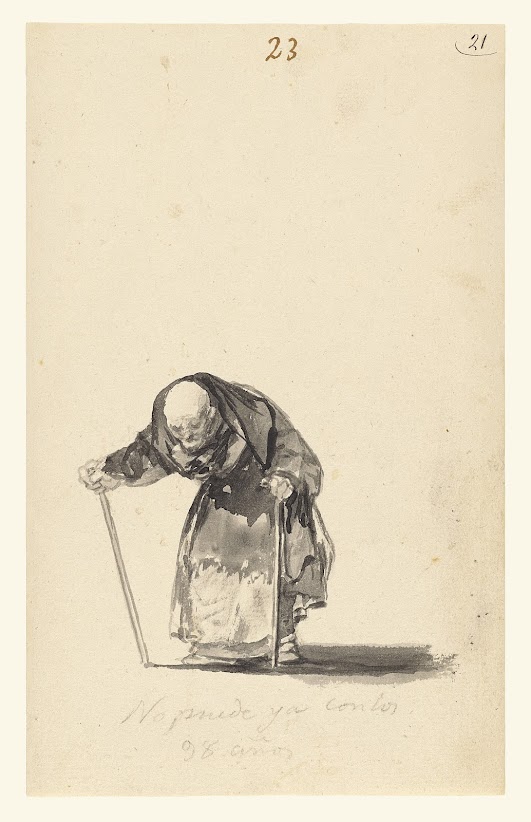 |
c1819-23 He Can No Longer at the Age of Ninety-Eight
brush and India ink 23.3 x 14.4 cm
The J. Paul Getty Museum, Los Angeles
|
 |
c1819-23 Bad woman
brush, gray and black Indian ink wash, black chalk strokes, on white paper 21.5 x 14.4 cm
Louvre, Paris
1820 Tiburcio Pérez y Cuervo Pérez’s loosely rolled up sleeves—a painterly tour de force—and relaxed expression combine with Goya’s nearly monochrome palette to create an exceptionally direct and informal portrait of the artist’s close friend, the architect Tiburcio Pérez. The year before, Goya had painted Pérez’s uncle, also an architect, in a far more regal and conventional portrait, which is today in the Cleveland Museum of Art. Pérez was responsible for the design of several institutional buildings in Madrid, including a medical school on the Calle de Atocha. |
 |
1820 Tiburcio Pérez y Cuervo (1785/86–1841), the Architect
oil on canvas 102.2 x 81.3 cm
Metropolitan Museum of Art, New York |
 |
1820-23 Witches' Sabbath, or the Great He-Goat
oil on mural transferred to canvas 140.5 x 435.7 cm
Museo del Prado, Madrid |
 |
| Witches' Sabbath, or the Great He-Goat detail |
 |
| Witches' Sabbath, or the Great He-Goat detail |
 |
1823 Portrait of Don Ramón Satué y Allué (1765-1824)
oil on canvas 107 x 83.5 cm
Rijksmuseum, Amsterdam |
 |
1824 Bullfight, Suerte de Varas
oil on canvas 49.8 x 70.8 cm
The J. Paul Getty Museum, Los Angeles |
 |
1824 Portrait of a Lady (María Martínez de Puga?)
oil on canvas 80 x 58.4 cm
The Frick Collection, New York |
 |
1824 Portrait of the Canon D. José Duaso y Latre
oil on canvas 74.5 x 59 cm
Museo de Bellas Artes de Sevilla, Spain |
 |
1824-25 Bull Attacked by Dogsl
lithograph on ivory wove paper 18.8 x 31.5 cm |
 |
c1824-28 Fire! Fire!
black chalk, lithographic pencil, on white-grey laid paper
18.8 x 15.1 cm
Louvre, Paris |
1825 The Bulls of Bordeaux (4 images): |
1825 Bullfight in a divided ring
lithographic crayon and scraper on light tan wove paper
30.4 x 41.3 cm (image) |
 |
1825 Picador caught by a Bull
lithographic crayon and scraper in black on buff wove paper
31.3 x 51.3 cm (image) |
 |
1825 Spanish Entertainment
lithographic crayon and scraper on light tan wove paper
30.1 x 40.6 cm (image) |
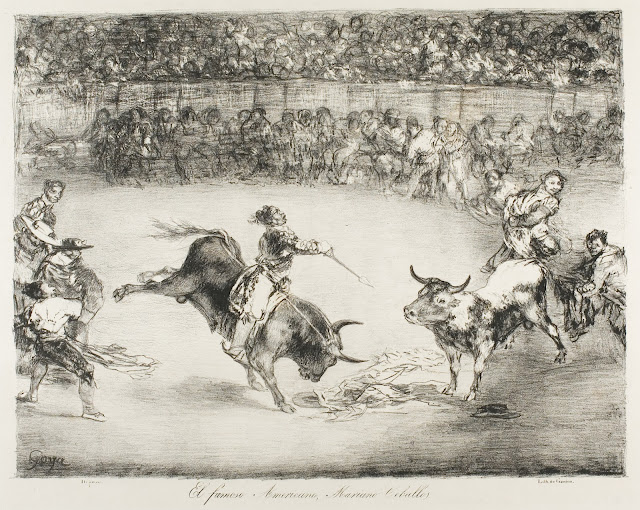 |
1825 The Famous American, Mariano Ceballos
lithographic crayon and scraper on ivory wove paper
31.1 x 40.5 cm (image) |
 |
1825-26 Modern Duel
lithographic crayon and scraper on ivory laid paper
19 x 19.5 cm (image) |
%20.jpg) |
1825-26 The Andalusian Dance
lithographic crayon on ivory laid paper 24.5 x 29 cm |
 |
1825-27 Old man on a swing
etching and burnished aquatint and/or lavis on ivory paper
18.8 x 12.2 cm (plate) |
 |
c1825-28 They are Dying
black chalk, lithographic crayon, stumping, on white laid paper 18.9 x 14.4 cm
The J. Paul Getty Museum, Los Angeles |
 |
1827 Juan Bautista de Muguiro
oil on canvas 103 x 85 cm
Museo del Prado, Madrid |
 |
c1827 The Milkmaid of Bordeaux
oil on canvas 74 x 68 cm
Museo del Prado, Madrid |
 |
c1894? An Officer
oil on canvas 63.2 x 48.9 cm
The Frick Collection New York City |
 |
c1915-20 The Forge
oil on canvas 181.6 x 125.1 cm |
 |
n.d. Christ in the Garden of Olives
(School og Goya)
oil on wood panel 47 x 35 cm
Louvre, Paris |
 |
n.d. Couple in a landscape
brush, sepia wash, preliminary red chalk lines, traces of black chalk, touches of grey wash, on white laid paper 20.3 x 14.2 cm
Louvre, Paris |
 |
n.d. Her devotion consoles her
(attributed to Goya)
scraper, brush, Indian ink wash, traces of black chalk, on white laid paper 25.5 x 18 cm
Louvre, Paris |
 |
n.d. Portrait of the Countess of Chincón
oil on canvas 82 x 61.7 cm
Uffizi Gallery, Florence |
 |
n.d. Scene at a Bullfight
oil on canvas 45 x 57 cm
© Ashmolean Museum, University of Oxford, UK |
 |
n.d. Scene at a Bullfight
oil on canvas 46 x 58 cm
© Ashmolean Museum, University of Oxford, UK |
 |
n.d. The Widow
brush, sepia ink wash, Indian ink wash, on white laid paper
20.3 x 14.2 cm
Louvre, Paris |
 |
n.d.The same thing
brush, Indian ink wash, black chalk strokes on white laid paper 26.2 x 18.4 cm
Louvre, Paris |


.jpg)


%20.jpg)


