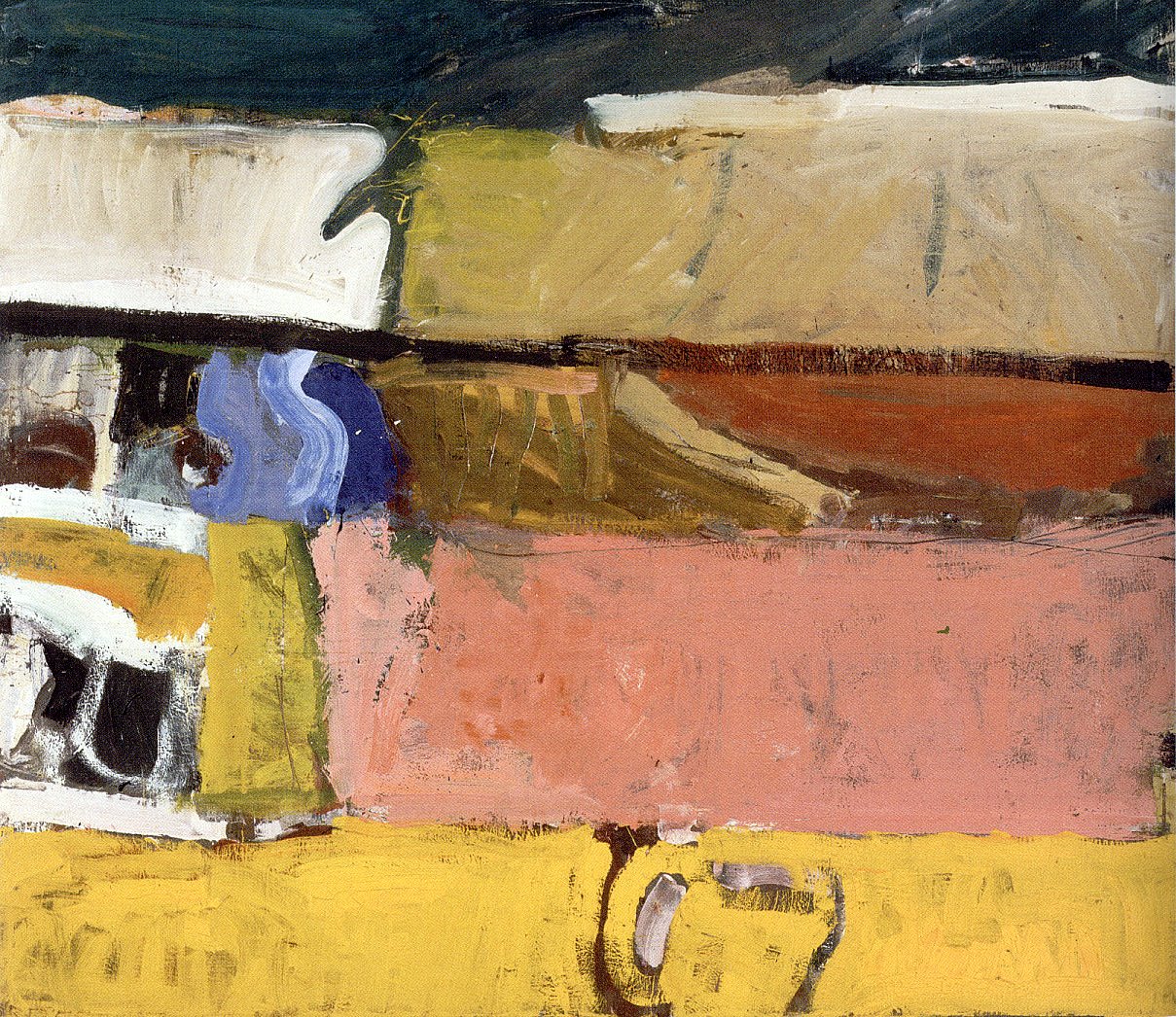
Diebenkorn's career spanned some four decades and culminated with a 25-year reign as one of America's pre-eminent abstract painters. Whilst not my personal favourites among his series of works (see previous post on his Berkeley series), the source of this reputation was his ‘Ocean Park’ paintings, a series begun around 1967 after the artist set up his studio in Venice, California. Celebrated as brilliant compositions of colour and paint, the Ocean Park paintings are both loose and structured, both moody and bright. Each canvas is meant to be episodic - of a day in the life of the artist.
Ocean Park itself is a community near Santa Monica, where Diebenkorn traces a daily path between home and studio, but whether or not these works make the topical references to local landscape with which they are credited, they clearly are something more than abstractions with recurrent compositional motifs and stunning juxtapositions of colour laid on with passion.
Diebenkorn substitutes reality with washes of colour, corrected and controlled by a drawn grid. His armature is loose, irregularly spaced and measured according to colour or scale, responding, always, to what Diebenkorn called ‘the incidental.’ While some may argue that this is nothing more than a repetitive theme, the real strength of this body of work are the myriad shifts and nuances that transform Ocean Park from piece to piece. The series displays a splendid range of colours and a variation of scale from small, intimate oil-on-wood works such as the Cigar Box Series (painted in the 1970s) to monumental tableaux. Though I have yet to see one ‘in the flesh’ the cigar box lid paintings are the ones I could find a little wall space for.
Cigar Box Lid #1
Cigar Box Lid #3
 |
| Cigar Box Lid #4 |
Cigar Box Lid #5
Cigar Box Lid #6
 |
| Cigar Box Lid #9 |
Cigar Box Lid #11
Ocean Park #19
 |
| Ocean Park #21 |
 |
| Ocean Park #24 |
 |
| Ocean Park #27 |
 |
| Ocean Park #30 |
 |
| Ocean Park #36 |
 |
| Ocean Park #40 |
 |
| Ocean Park #43 |
 |
| Ocean Park #46 |
 |
| Ocean Park #48 |
Ocean Park #49
 |
| Ocean Park #54 |
 |
| Ocean Park #60 |
 |
| Ocean Park #63 |
 |
| Ocean Park #67 |
 |
| Ocean Park #79 |
 |
| Ocean Park #86 |
Ocean Park #95
 |
| Ocean Park #105 |
Ocean Park #107
Ocean Park #114
Ocean Park #115
 |
| Ocean Park #116 |
Ocean Park #118
Ocean Park #125
 |
| Ocean Park #128 |
 |
| Ocean Park #129 |
 |
| Ocean Park #130 |
 |
| Ocean Park #139 |
Ocean Park #140
This is the second of three postings on the work of Richard Diebenkorn and is looking specifically at his ‘Berkeley’ series. For an overview of his work and biographical notes see the previous blog post.
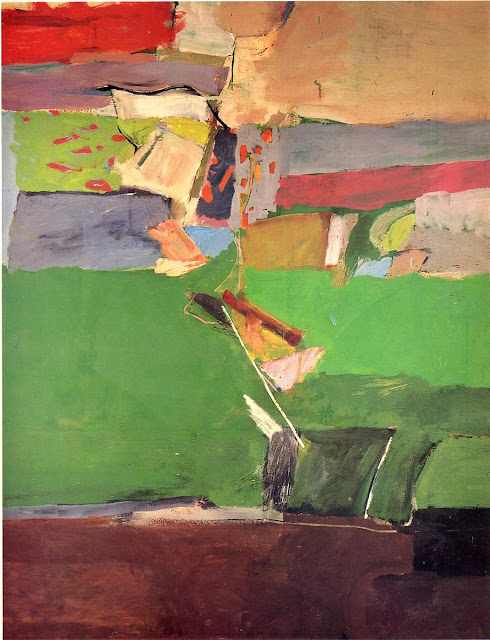
Richard Diebenkorn's Berkeley series were executed in a twenty-month period between 1953 and 1955. Apart from being my personal favourites of his work, mainly because they’re colourful semi-abstracted landscapes, these paintings give the viewer an excellent opportunity to examine the work of a major artist in the process of his stylistic development. With this series Diebenkorn achieved his first widespread, formal recognition as an important figure in the Abstract Expressionist movement.
When Diebenkorn returned to Berkeley in 1953, after completing his graduate degree at the University of New Mexico in Albuquerque and teaching for a year at the University of Illinois, he began the Berkeley series, which was to number over forty paintings.
The Berkeley series shows Diebenkorn's absorption of New York Abstract Expressionism which he adapted to his own Western environment and personal idiom. It is important to recognize however, that Diebenkorn belongs to the first generation of Abstract Expressionists along with such Bay Area artists as Hassel Smith and Frank Lobdell. His work in Berkeley represents a fully formed achievement contemporary with that in New York that announced the arrival of the American avant-garde on the world scene.
The early Berkeley pictures, such as Berkeley #8 (1954) are, like the previous works done while still in Albuquerque, cut by horizontal lines or bands of colour suggesting a hilly landscape. Their colours are also reminiscent of the pinks and browns of the earlier New Mexico paintings.
1954 Berkeley #8
Berkeley #23 and #39 have an increased variety of colour and calligraphic vitality. The grid-like sections of heavily stroked paint are separated by fragments of line drawing, giving the effect of an aerial landscape ending in a narrow strip of sky. Some of the last paintings in the series return to the desert landscape colours arranged in a more ordered formality.
1955 Berkeley #23
All of the Berkeley pictures are executed with bold brushwork. By scraping and scratching at the colours in these pictures, Diebenkorn achieved a stronger linear element than previously seen in his work. Large blocks of colour seem to tumble together, but the compositions are held firm by diagonal, horizontal, or vertical stripes of darker colour which originate at the sides of the canvases and move directly into the centre of the composition or frame it at the edges. The results are luscious pictures in which spontaneity is tempered by the logic of the structural elements.
Diebenkorn's approach to the Abstract Expressionist style differs markedly from that of his New York contemporaries. His line is restrained compared, for example, to the compulsive, energetic line of Franz Kline; Diebenkorn's canvases are composed of flat, brushed, horizontal colour patches, whereas in the works of Jackson Pollock colours were dripped and poured. Diebenkorn's colour sense is distinctly Californian: warm earth colours dominate as opposed to the blacks, grays and whites that generally characterize the New York school.
The Berkeley series pictures were immediately exhibited on both West and East coasts: three were sent to the Third Sao Paulo Biennale in 1955. Following this series Diebenkorn painted a group of still lifes, another of figurative works, and numerous cityscapes. In 1969, after moving to Southern California, he began the Ocean Park series which will feature in the next blog post coming up.
1953 Berkeley #1
 |
| 1953 Berkeley #3 |
1953 Berkeley #5
 |
| 1953-54 Berkeley #7 |
1954 Berkeley #12
 |
| 1954 Berkeley #13 |
1954 Berkeley #19
 |
| 1954 Berkeley #20 |
1954 Berkeley #22
 |
| 1954 Berkeley #23 |
 |
| 1954 Berkeley #26 |
1955 Berkeley #32
1955 Berkeley #39
 |
| 1953 Berkeley #44 |
1955 Berkeley #46
1955 Berkeley #47
1955 Berkeley #52
1955 Berkeley #54
1955 Berkeley #57
 |
| 1955/56 Berkeley #58 |
 |
| 1953 Berkeley #59 |