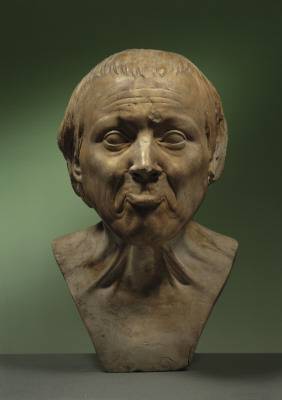
Watched BBC 4's new series presented by Art Historian Andrew Graham-Dixon "The Art of Germany" the other night. He covered the Gothic period in the first episode, and had a look at the remarkable sculptures of Franz Xaver Messerschmidt (1736-1783). We only saw a few of them on the programme so I thought I'd post a few more of them.
Messerschmidt was German-Austrian, and sculpted the heads in 1770-72. At this time he suffered from delusions and hallucinations, or a “confusion in the head” as his employer, the Viennese Academy of Fine Arts, described it. In 1774, Messerschmidt was expelled from the academy.
In 1781, Messerschmidt stated that the heads had been created as a record of his facial expressions on pinching himself to alleviate the pain of an illness he suffered, known now to be Crohn’s Disease. He intended to sculpt the 64 “canonical grimaces” of the human face using his own as a template.
Messerschmidt also claimed that he was physically tortured by “the Spirit of Proportion”, an ancient being who guarded the knowledge of harmony and who was angered by Messerschmidt’s disharmonius work. Personally, I think they're tremendous works, and wouldn't look at all out of place in an exhibition of contemporary work today.
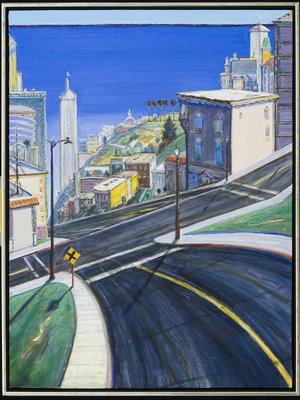
In the last of three postings on the paintings of Wayne Thiebaud (cakes, landscapes, and cityscapes) I'm taking a look at some of his cityscapes. Based on San Francisco with its dramatic hills where the roads rise and fall quite precipitously in places, they're a fanciful and exaggerated version of the reality.
For biographical information on Thiebaud see my two previous posts.
For the second of my posts on Wayne Thiebaud (For more biographical detail see the previous post) I am showing some of his landscape paintings. In 1963, Thiebaud turned increasingly to figure and landscape painting. Beginning in the 1970s, he began painting San Francisco cityscapes, wildly distorted views of the city's streets and hillsides that are reminiscent not only of Richard Diebenkorn's cityscapes from the mid-sixties but also the Precisionist paintings of Charles Sheeler and Georgia O'Keefe (for his cityscapes see my next post). His most recent landscapes dating from the mid-1990s share many of the same spatial and planar distortions seen in the cityscapes but utilise hotter colour and flattened planes to create the imagery.