Monday, 10 March 2025

Betty Swanwick - part 2


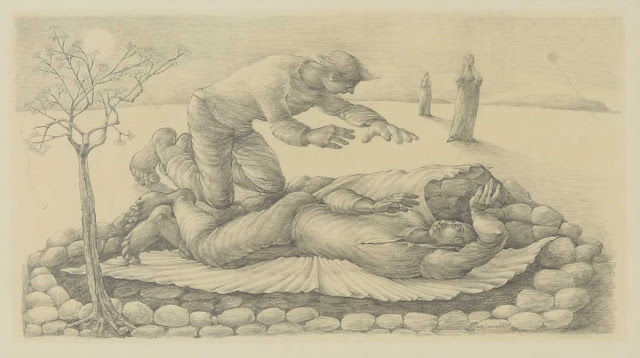
Betty Swanwick's long and varied career encompassed writing novelettes, painting, illustration and design. A true visionary, Swanwick's works are influenced by her own dreams and are highly spiritual. Described by Chris Beetles as a 'watercolourist of mystical symbolism enriched with a strange beauty', Swanwick's pieces use symbolism to convey an understanding of the complexity of life. This type of narrative, visionary work occurred late in the artist's career. Swanwick initially studied at Goldsmiths College of Art, and her first commissions were primarily for murals. Her mural work, such as the piece commissioned for the Rocket restaurant during the Festival of Britain in 1951, contain a sense of joy and fun that would go on to underpin Swanwick's practice for the following decades. The artist herself, however, considered her later narrative pieces to be her best work. Swanwick resigned from her teaching post at Goldsmith’s College, which was prompted by the formalisation of arts education, a change that resulted in what Swanwick described as a 'cultural narrowness'. This refusal to bow to convention is evident throughout Swanwick's career, which consistently valued eccentricity and originality over conformity.

The English pastoral landscapes that recur both in Swanwick's early work and later narrative pieces often act as the setting for myths or Biblical scenes. Pandora (lot 120), a watercolour where the Greek myth is re-imagined in a field of beehives, is a typical example of this. As a result of her use of the English pastoral, many critics have drawn a link between the artist and Stanley Spencer, whose own paintings and drawings, such as the Marriage at Cana series (lots 30 – 33), also placed Biblical events in a contemporary English context. Swanwick repeatedly refuted this link, instead listing Samuel Palmer and William Blake as her key influences. By placing herself within the context of Palmer and Blake, Swanwick was referring to, in her own words, 'a small tradition of English painting that is a bit eccentric, a little odd and a little visionary'. The following collection of works, amassed over several decades, provide a unique insight into this eccentric, odd and visionary work, that conveys life in all its complexity.


For more information and for earlier works see part 1 also.

This is part 2 of a 2-part series on the works of Betty Swanwick.


1980 The Monaghan Shroud
watercolour on paper 49 x 52 cm

1980s Study of the artist's cat Bewick
pencil on paper 12 x 17.5 cm 

1981 The Walk to the Paradise Garden
pencil & watercolour on paper 43.3 x 40.6 cm 

1981 The Grain of Mustard Seed
pencil & watercolour on paper 62.8 x 45.1 cm
exhibited in the Royal Academy, London 1982

1982 The Right Chair for the Occasion
pencil & watercolour on paper 60.5 x 50.2 cm

1982 Ophelia
pencil & watercolour on paper 53 x 46.5 cm

1982 Feeding the Flocks
pencil & watercolour on paper 54.5 x 71.5 cm
exhibited at the Royal Academy of Arts, Summer Exhibition 1983

1984 The Retreat
pencil on paper 49.5 x 52.1 cm

1984 Study for The Key of the Kingdom
pencil on paper 54.3 x 21 cm

1985 The Wine Divine
pencil on paper 50.8 x 60.9 cm
exhibited in the Royal Academy Summer Exhibition, London 1987

1985 Preparatory sketch for The Parliament of the Yard
 pencil on paper 73 x 34.5 cm
exhibited in the Royal Academy of Arts, Summer Exhibition, London 1987

1985 Feeding the Birds, preliminary study for Parliament of the Yard
pencil on paper 56.5 x 29.6 cm

1987 The Black Shepherd
pencil on paper 30 x 71 cm
exhibited in the Royal Academy of Arts, Summer Exhibition 1988

1987 Happy Christmas; for the Celia Hammond Animal Trust
13 x 20 cm

1989 Leda and the Swan
pencil on paper 36.8 x 72.4 cm

Note: Dates were not found for the remainder of this post:

Christmas card design for the Celia Hammond Animal Trust
pen over pencil 21 x 25 cm

Dan's Journal by Ronald Duncan
Front Cover

Dan's Journal

Dan's Journal


Dan's Journal

Figure study for a book cover
pencil on paper 41.3 x 38.1 cm

Outhouses Blasted by a Storm
pencil on paper 26 x 38 cm

Portrait of a lady
oil on vanvas 50.8 x 40.6 cm

Portrait of a lady
oil on canvas 55.8 x 45.7 cm

Preparatory sketch for The Key of the Kingdom
pencil on paper 64.5 x 21 cm

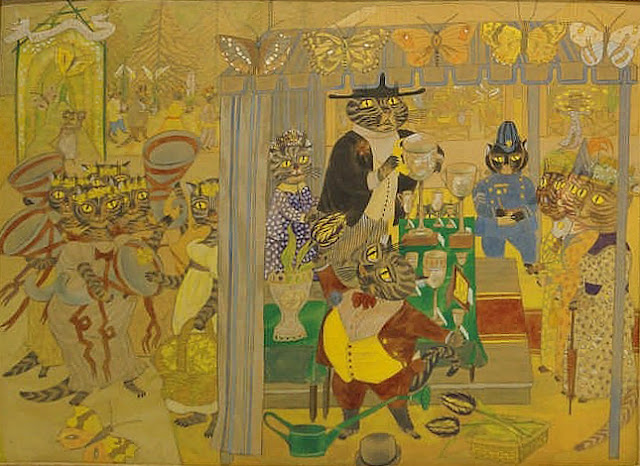
Rodney Village Flower Show
 watercolour and gouache over pencil on buff paper
50.9 x 69.9 cm

Seated Woman
pencil on paper 44.5 x 30.5 cm

Safety First!
colour lithograph poster for the Ministry of Transport
gouache over pencil 97.5 x 59 cm

Sketch for "The Divestyre of the Dreamer of Dreams"
pencil on paper 51 x 69 cm

Sketch for "The Folly"
pencil on paper 47.5 x 55.5 cm

Still Life
oil on canvas 40.6 x 50.8 cm

Swans
pastel and charcoal on paper 26 x 34.5 cm
 
The miracle of the loaves and fishes
pencil on paper 55 x 41,5 cm

The Mercat Dream
watercolour, pencil and gouache on paper 23 x 32 cm

The Gardeners
gouache over pencil 64 x 105.5 cm

sketch for The Reawakening
pencil on paper 52 x 74cm


Study for The River
pencil & watercolour on paper 48.3 x 50.8 cm

The Sightless Man
pencil & watercolour on paper 50 x 38 cm

Women preparing for a banquet
watercolour 64 x 50 cm

Untitled
pencil on paper 45.7 x 48.3 cm

The Fancy Hat
gouache on paper 27 x 31 cm


Friday, 7 March 2025

Betty Swanwick - part 1

Betty Swanwick c1948

Very early in her career, Betty Swanwick established herself as an illustrator and designer of great wit and invention, so complementing her friend and teacher, Edward Bawden. Later, she produced an extraordinary series of visionary watercolours and drawings in the tradition of William Blake and Samuel Palmer, which led to her election as a Draughtsman Member of the Royal Academy. She was born on 22 May 1915, the elder daughter of Harry Swanwick, who developed as a marine watercolourist while serving as a Paymaster in the Royal Naval Reserves. She was baptised at St Peter’s Church, Aldborough Hatch, near Ilford, Essex. Swanwick was educated at a local LCC elementary school, and later at the Prendergast Grammar School, Lewisham, South London. She received her first lessons in art from her father, and was encouraged by her art mistress at the Prendergast. Her father died when she was ten years old, a loss that threw her upon her own determination to develop as an artist. During her formative years and into early adulthood, Swanwick would continue to live in South London, first at Forest Hill and then at Sydenham. At the age of fifteen, she entered Goldsmiths’ College School of Art, where she was encouraged by Clive Gardiner, the Headmaster, and Edward Bawden, her tutor. Four years later, she received scholarships to both the Central School of Arts and the Royal College of Art, and attended them at the same time as Goldsmiths.

Swanwick received commissions even before such friends and contemporaries as Carel Weight and Denton Welch. As a result of seeing her work at a student exhibition at Goldsmiths in 1936, Frank Pick commissioned her to design her first posters for London Transport, and other projects soon followed. In the same year, she returned on a part-time basis, to teach Illustration at Goldsmiths, as a successor to Bawden. Highly talented – and highly respected by her students – she taught at Goldsmiths through the Second World War, and became a full-time Senior Assistant in the Illustration School in 1948. During this post-war period, she developed her range as an artist, painting watercolours and murals, providing illustrations for books and periodicals, and designing further posters.


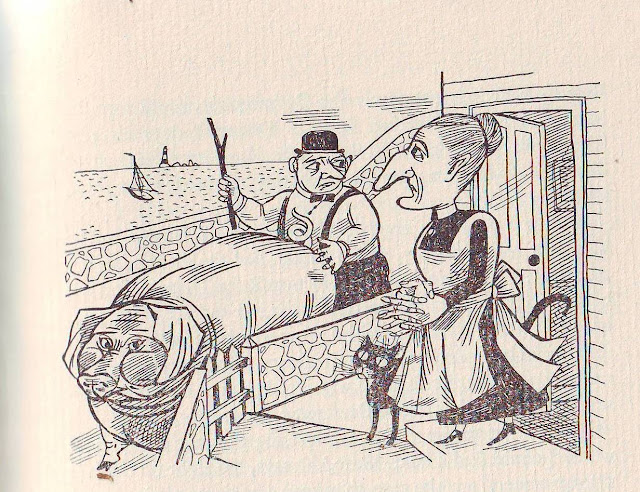
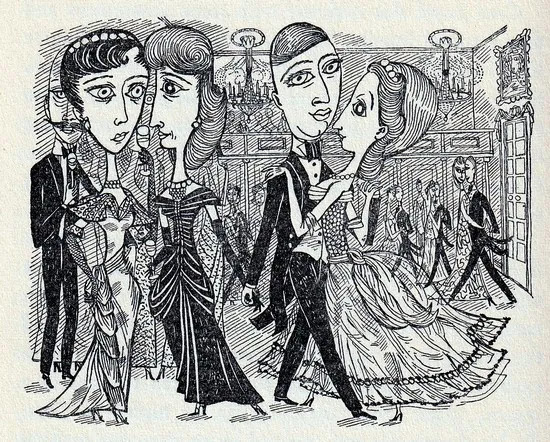
Having begun to illustrate books from 1939, Swanwick produced her own texts, for both children and adults, from 1945. Describing her idiosyncratic social comedies for adults as ‘novelettes’, she populated them with large-headed wide-eyed figures with tiny feet. Though they hardly hinted at her later, more spiritual preoccupations, the images amply demonstrated her instinctive wit, her innate sense of design and her skilful draughtsmanship. As a whole, the publication of these books marked an important step towards the recognition of her originality, John Betjeman calling Hoodwinked (1957), ‘strange, startling, funny with a weird beauty’. In 1950, a rare solo exhibition at The Little Gallery provided a showcase for Swanwick’s anthropomorphic watercolours, which combined her love of animals and sense of fun in the most delightful way. Her mural designs, for venues such as the Festival of Britain (1951) and the Evelina Children’s Hospital (1955), were equally successful manifestations of her jaunty early style.


Soon after the retirement of Clive Gardiner from Goldsmiths in 1958, Swanwick became aware that the new Principal, Patrick Millard, was introducing changes in methodology that favoured the avant-garde. Most damaging for Swanwick was that drawing in general, and illustration in particular, was marginalised. Increasingly ostracised by those who represented the new order, she would seek solace in artistic certainties, and so carried with her a facsimile of one of Samuel Palmer’s sketchbooks. She eventually resigned as Senior Lecturer in 1970, and left her home in Greenwich for Downgate, Tidebrook, Sussex. By this time, Swanwick was working increasingly on large-scale figurative watercolours and drawings, and exhibiting them regularly at the Royal Academy Summer Exhibition. Gradually receiving some recognition, she was elected an Associate of the Royal Academy in 1972, and a Royal Academician seven years later. She was also elected a member of the Royal Society of Painters in Water-Colours in 1976.

In the poetry and intensity of the late narrative pictures, there is a level of achievement that suggests that Swanwick had overcome earlier anxieties. Yet there was something in her character that stopped her being as well known as she might have been. She preferred to spend her time working – and, as a perfectionist, completing work with difficulty – at home, and in the company of her dogs, her cats and Jobo, her African Grey parrot.

On returning to Greenwich in 1973, Swanwick taught again at Goldsmiths for one day a week and continued to do so for five years, by which time she had settled in Tunbridge Wells, Kent.

Swanwick died in hospital, in Tunbridge Wells, on her birthday, 22 May 1989. She left her money to four charities: the Celia Hammond Animal Trust, Friends of the Earth, Greenpeace and the World Wildlife Fund.


Footnote: My wife (illustrator Pauline Ellison) and I live in Tunbridge Wells. We knew Betty well and enjoyed afternoon teas at her cottage in the “Village” area, accompanied by her talkative (rude) parrot. She was a lovely lady; when she gave up working at the easel she gave her three-legged “easel stool” to Pauline:


This is part 1 of a 2-parts  on the works of Betty Swanwick:


1936 To the fields
colour lithograph poster for London Transport
101.6 x 63.5 cm 

1936 By Green Line
colour lithograph poster for London Transport
101.6 x 63.5 cm 

1936 To the farms
colour lithograph poster for London Transport
101.6 x 63.5 cm.

1936 Smithfield Club Cattle Show
colour lithograph poster for London Transport


1936 Fly away in Sussex
colour lithograph poster for London Transport
101.6 x 63.5 cm

1937 Life Study
 pencil on paper 25.5 x 47.2 cm

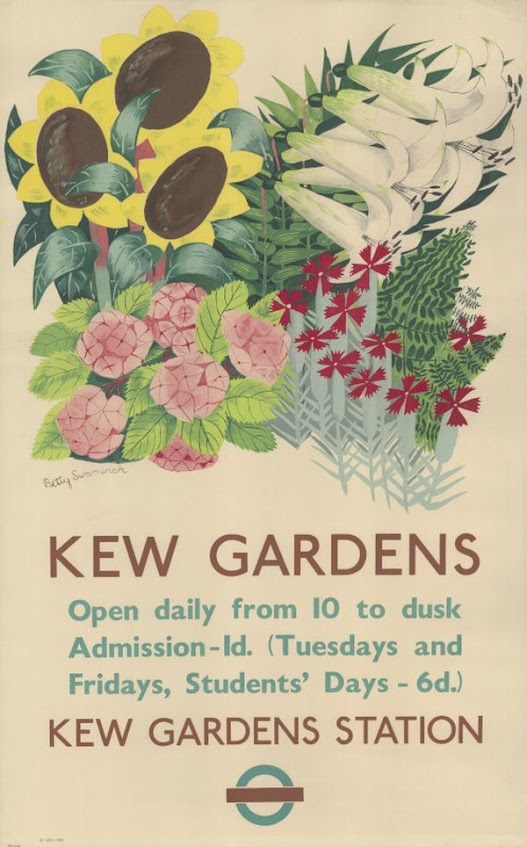
1937 Kew Gardens
colour lithograph poster for London Transport
102 x 64 cm

1937 Kew Gardens
colour lithograph poster for London Transport
102 x 64 cm

1937 Chestnut Time Bushy Park by Underground
colour lithograph poster for London Transport

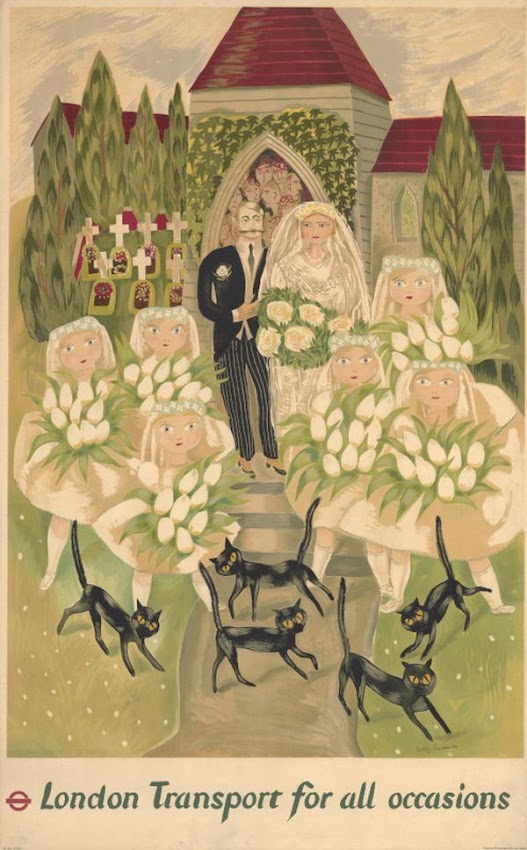
1938 London Transport for all occasions
colour lithograph poster 102 x 64 cm

1945 Cover of The Cross Purposes by Betty Swanwick
"The Garden Party"
 published by Editions Poetry, London

The Cross Purposes
The Brother and Sister.

The Cross Purposes
The Ceremony

1949 Enjoy Your London Underground
No.4 The River
colour lithograph poster for London Transport


1949 Enjoy Your London Underground
No.4 The River


1949 Enjoy Your London Underground
No.4 The River


1949 Poster for London Transport
colour lithograph 13 x 62 cm

1949 Poster for London Transport
detail

1949 Poster for London Transport
detail

1949 Poster for London Transport
colour lithograph 17 x 62 cm

1949 Poster for London Transport 
detail

1949 Poster for London Transport 
detail

1954 Wild or Savage
colour lithograph poster for London Zoo
 102 x 64 cm

Hoodwinked: Written and Illustrated by Betty Swanwick
front cover

Hoodwinked: Mr. Fox’s suicide.


Hoodwinked: Madeleine, Cora, Castor, and Gemma.


Beauty and the Burglar: written and Illustrated by Betty Swanwick


Beauty and the Burglar: Coshing Class


c1960's  The Mercat Dream
watercolour, pencil and gouache on paper
23 x 32 cm

c1967 Preparatory Sketch for "The Pool"
pencil on paper 64 x 35 cm


c1967 Preparatory Sketch for "The Pool"
(size not given)


1970 by The River: Study for The River pencil and watercolour on paper 48.3 x 50.8 cm 


1970 Original menu card for the Spread Eagle restaurant, Greenwich, London

1973 Selling England by the Pound
cover of the fifth studio album by the English progressive rock band Genesis

c1974 Preparatory sketch for The Wilderness Regained
pencil on paper 27.5 x 35.5 cm

1975 The Flight of the Doves
pencil, watercolour and gouache on paper 43.2 x 52.1 cm

1975 The Eye of the Beholder
pencil on paper 26 x 51 cm

1976 The Strange Reply
watercolour on paper 46 x 48 cm

1976 The Awakening
pencil on paper 32.5 x 56 cm
exhibited at the Royal Academy of Arts Summer Exhibition 1978

1978 Primavera and the Sleeping Gardener
pencil on wove paper
Royal Academy Collection, London

1978 Pandora
pencil & watercolour on paper 62 x 51 cm
exhibited in the Royal Academy of Arts, Summer Exhibition 1979

1979 The Monaghan Shroud
pencil on wove paper 54.8 x W 62.5 cm

1980 Romanoff Conservatory
(Conservatory on Romanoff Lodge, Tunbridge Wells)
 pencil on paper 26.5 x 27 cm

1980 One amongst us
pencil & watercolour on paper 48.3 x 58.4 cm

1980 Design for a cat scarf
pencil on paper 65.5 x 65.5 cm